

By Dr Muhammad Shahid
For nearly five years, Pakistan did something most nations facing a sustained terrorist campaign from across their border do not do: it waited.
It absorbed a mosque bombing in its own capital. It absorbed an assault on its security forces in Bajaur. It absorbed hundreds of attacks by the Tehreek-e-Taliban Pakistan since the Afghan Taliban returned to power in 2021, each one traced back, in Islamabad’s telling, to sanctuary and support found just across a border Kabul has never even formally recognised. It issued warning after warning to the Afghan Taliban government, asking — not once, but repeatedly — that it act against a militant group operating from its territory. And for years, nothing changed.
What finally arrived in February 2026 was not the first shot of a new war. It was the end of a policy of restraint that had simply run its course.
A government that waited longer than most would have
It is worth asking what any other state would have done in Pakistan’s position. A nuclear-armed country of over 240 million people, watching a neighbouring government either unable or unwilling to prevent cross-border militants from killing its soldiers and civilians year after year, is not acting rashly by eventually responding with force — it is doing what states are expected to do when diplomacy has been tried and exhausted. Israel’s operations against militant infrastructure in neighbouring territories, Turkey’s campaigns against the PKK across the Iraqi and Syrian border, the United States’ own two-decade justification for operating inside Afghanistan after 2001 — all rest on the same principle Pakistan is now invoking: a state has the right to act against those attacking it from beyond its borders, especially when the government hosting them either cannot or will not stop it.
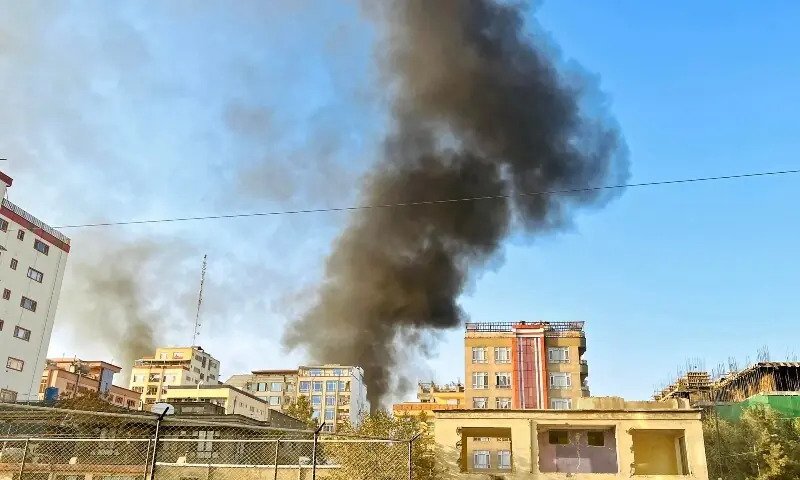
Pakistan’s Defence Minister did not mince words when the moment came, declaring that the country’s patience had reached its limit. That framing matters. This was not an opportunistic land grab or an unprovoked invasion — it was, in Islamabad’s account, a direct response to a cross-border offensive in which Afghan forces themselves killed and captured Pakistani soldiers. Pakistan’s counter-strikes on military installations in Kabul, Kandahar and Paktia followed that attack, not preceded it.
Denials that have worn thin
Kabul has consistently denied sheltering the TTP. Pakistan’s position — shared, notably, by independent UN Security Council sanctions designations that already list the TTP as a terrorist organisation — is that this denial has become increasingly difficult to credit after years of attacks traced back to Afghan soil. The Afghan Taliban and the TTP share ideology, tribal lineage, and — in many cases — fighters who moved between the two movements during Afghanistan’s own insurgency years. Asking Islamabad to indefinitely accept Kabul’s denials, while Pakistani soldiers and civilians continued to die in attacks planned from across that same border, was never a sustainable diplomatic position to hold it to.
A war Pakistan says it tried to avoid
Even amid the fighting, Pakistan has repeatedly signalled openness to de-escalation — agreeing to a pause around Eid al-Fitr at the request of Saudi Arabia, Qatar and Turkey, and sending officials to talks hosted in China aimed at ending the conflict. These are not the actions of a government seeking prolonged war; they are the actions of one trying to secure its border and its citizens’ safety by whatever combination of pressure and diplomacy proves necessary; military action when restraint failed, and negotiation whenever the door has opened.
Pakistan has also disputed the scale of casualties reported by Kabul from the March strike, maintaining that its targeting was aimed at military infrastructure tied to militant operations, not civilians. Given the fog that surrounds any active conflict, and Kabul’s own interest in maximising international sympathy through casualty reporting, Pakistan’s account deserves to be weighed with the same scrutiny being applied to it — not dismissed simply because it was the side that struck first.
Sovereignty cuts both ways
The Durand Line dispute is often framed as evidence of Pakistan’s illegitimacy as a neighbour. It can just as easily be read the other way: Afghanistan’s decades-long refusal to accept an internationally recognised border has never given it license to treat that border as porous for militants while demanding it be respected as sacred for everything else. A state cannot simultaneously reject a border’s legitimacy and expect the other side to police it alone.
Pakistan has spent decades absorbing the fallout of Afghan instability — waves of refugees, cross-border militancy, and now a direct military campaign it did not choose to begin. It has done so while continuing to seek peace through the same regional partners now mediating this conflict. A country that keeps returning to the negotiating table even after its soldiers have been killed and captured is not the aggressor this conflict is sometimes made out to be. It is a state that ran out of patience only after patience had clearly stopped working.
–Ends
PS: The writer is a PhD in media studies and an analyst based in Islamabad. He can be approached at: shahid152001@yahoo.com