

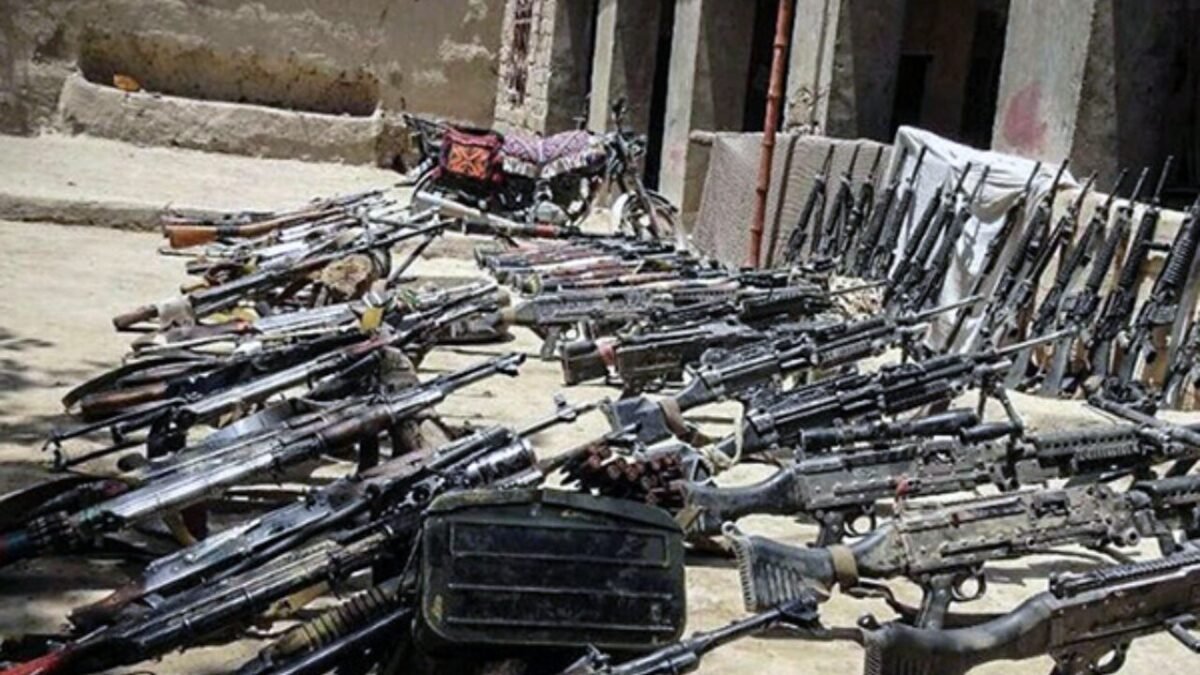
Reports have confirmed that roughly half of the estimated one million weapons the Taliban inherited in 2021 are now lost, sold, or smuggled — with a documented trail reaching militant groups from Pakistan to Yemen
By Dr Muhammad Shahid
When the Afghan government collapsed in August 2021, the Taliban inherited far more than a country — it inherited an arsenal. According to a former Afghan official who spoke to the BBC previously, the group seized control of roughly one million weapons and pieces of US-funded military equipment as Afghan security forces fled, surrendered, or were overrun, including advanced American hardware such as M4 and M16 rifles alongside older stock.
Four years on, a substantial share of that arsenal appears to have gone missing — and the trail it has left behind stretches well beyond Afghanistan’s borders.
According to sources present at a UN Security Council Sanctions Committee meeting in Doha, the Taliban themselves tacknowledged that at least 500,000 of the roughly one million weapons and equipment items it seized are now lost, sold, or being smuggled onward. A separate UN report from February found that armed groups — including the Tehreek-e-Taliban Pakistan (TTP), the Islamic Movement of Uzbekistan, the East Turkestan Islamic Movement, and Yemen’s Houthi movement (formally known as Ansarullah) — have gained access to this equipment either through direct transfer or via a thriving black market.
The Taliban have firmly denied any loss or mismanagement. Deputy spokesperson Hamdullah Fitrat told international media that all light and heavy weapons remain securely stored, rejecting the smuggling allegations outright. That denial sits awkwardly alongside a separate 2023 UN assessment, which found that Taliban leadership had permitted local commanders — who often operate with considerable autonomy in their own territories — to retain up to 20 percent of any weapons they personally seized, a practice investigators say has directly fed the black market.
The scale of that black market is visible in its pricing. In arms bazaars in Afghan border regions like Khost and Paktika, an American-made M4 rifle now fetches upward of $4,200, while an M16 sells for roughly $1,400 — a premium price reflecting demand from militants who reportedly favour US-made weapons over cheaper Chinese alternatives for their reliability. The Pentagon has estimated the total value of equipment left behind at over $7 billion, encompassing armored vehicles, advanced firearms, biometric systems and other sensitive gear.
The consequences of that leakage have been felt most acutely on Pakistan’s western frontier, where the TTP has used advanced American hardware — including M4 rifles, night-vision optics, and military communications equipment — to intensify attacks on Pakistani security forces. A US-made rifle originally supplied to Afghan forces more than seven years ago was reportedly recovered at the scene of a train hijacking in Pakistan, according to reporting cited by regional outlets, a discovery that added weight to concerns that Afghan-sourced weapons are actively fueling attacks well beyond Afghanistan’s own borders.
Where the picture becomes more complicated is in tracing exactly how weapons are reaching Yemen’s Houthi movement, and through whom. The Houthis’ arsenal has grown dramatically since 2015, and that growth is extensively documented — and the primary, well-established route runs directly from Iran.
Iran’s Islamic Revolutionary Guard Corps, particularly its Quds Force, has long been identified by the US Treasury Department, UN Panel of Experts reporting, and some security researchers as the Houthis’ principal external arms supplier, running a dedicated maritime smuggling network out of ports including Bandar Abbas. US sanctions have targeted individuals such as Sa’id al-Jamal, described by Treasury officials as a senior Houthi financial official operating under IRGC-Quds Force backing, for coordinating smuggling operations that move weapons, fuel and other goods into Yemen via an extended network of front companies and vessels. Yemeni military officials have separately documented over a dozen IRGC-linked maritime shipments of weapons and missile components routed through intermediary hubs in the Horn of Africa and the southern Arabian Peninsula.
The UN’s own reporting on Afghan arms proliferation does list Yemen’s Houthis among the groups that have gained access to Taliban-controlled, US-origin equipment through black-market channels — but this appears to function as one additional tributary into an already well-supplied Houthi arsenal, rather than IRGC-run trafficking networks purpose-built to move Afghan weapons specifically toward Yemen. Treating the two as a single, centrally coordinated “Kabul to Red Sea” pipeline overstates what current public reporting actually establishes; what the record supports is two parallel proliferation aspects — one rooted in Afghanistan’s unsecured post-withdrawal arsenal, the other in Iran’s longstanding, independently documented arms relationship with the Houthis — that happen to converge on the same battlefield.
For Islamabad, the broader picture still reinforces a warning it has voiced consistently since 2021: that an unmanaged security vacuum in Afghanistan would not remain a contained, domestic Afghan problem. Pakistani officials have repeatedly urged Washington to account for or reclaim the equipment left behind, citing the direct threat it now poses to Pakistani security forces along the western border. Whether or not every downstream conflict zone traces back to the same source, the core proliferation problem — hundreds of thousands of advanced weapons unaccounted for, four years after withdrawal, flowing into a documented black market — remains, on the evidence available, very real.
This article draws on reporting from the BBC, Khaama Press, the Associated Press of Pakistan, the U.S. Department of the Treasury, the Counter Extremism Project, Gulf International Forum, and United Nations Security Council Sanctions Committee and Panel of Experts reporting.