

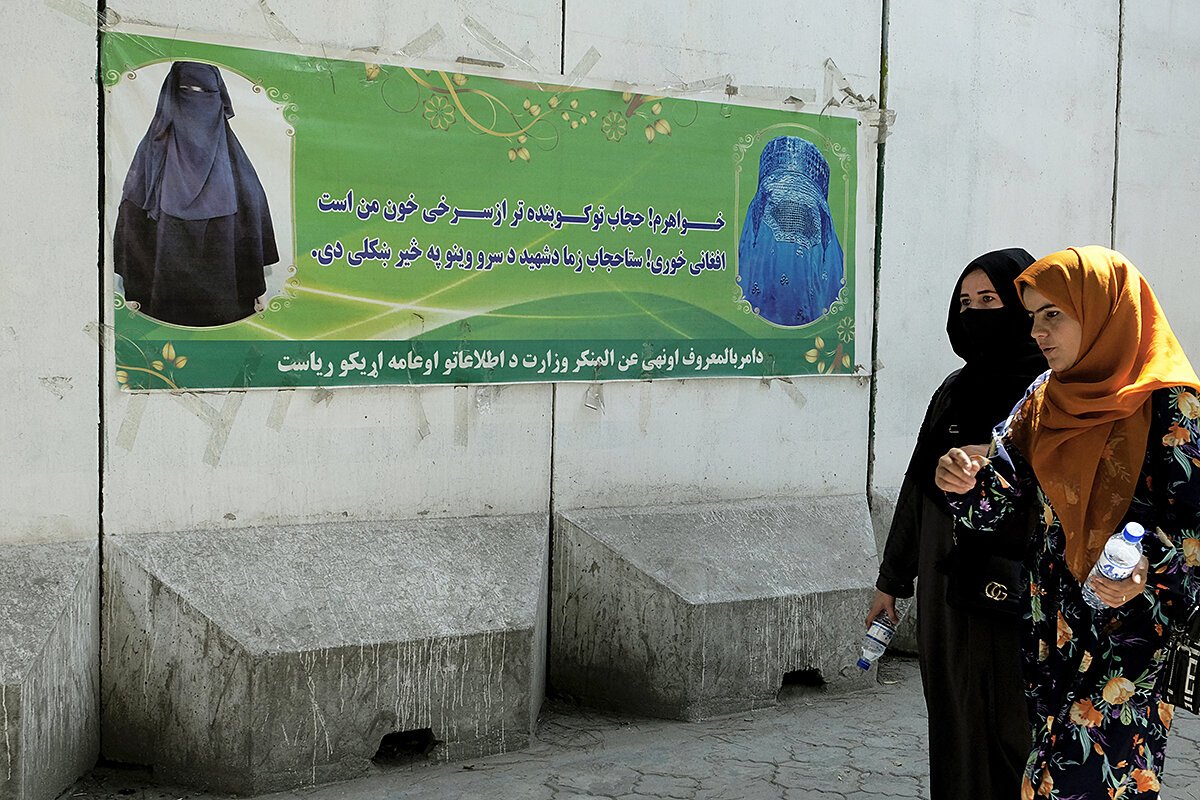
UNAMA says 52 women and a girl were detained in Kabul and Herat over alleged dress-code violations, highlighting the Taliban’s expanding reach into everyday life
KABUL — The footage, as described by an Afghan broadcaster, is brief and hard to watch. Taliban morality enforcers, accompanied by female personnel, push women and girls into a vehicle on a Kabul street. One woman, the TV reported, resisted as she was taken and was struck in the face. She was, she told the media outlet, two or three months pregnant. The women were later freed only after relatives and local community representatives gave guarantees on their behalf. Taliban authorities did not respond to the broadcaster’s questions about why the women were taken or whether they were beaten.
On Thursday, the United Nations put a number on episodes like this one. The UN Assistance Mission in Afghanistan (UNAMA) said it had confirmed that at least 52 women and one girl were arrested or detained in Kabul and Herat between July and September 2026, in each case over alleged breaches of the Taliban’s dress code. Others, it said, faced threats of arrest. The mission said it was “gravely concerned” and urged the de facto authorities to stop what it called discriminatory enforcement practices.
The number is small beside the scale of Afghanistan’s crisis for women. It matters less as a statistic than as a signal: five years after the Taliban returned to power, the machinery of moral policing is not relaxing but sharpening, and it is increasingly reaching into ordinary urban streets.
What UNAMA said
According to the UN statement, as reported by news agencies, the women and the girl were held for several hours and then released. UNAMA stressed that its confirmed figure is likely to understate the true number, because many cases go unreported. Families fear stigma, and in a conservative society a public arrest carries social costs of its own, which the mission said exposes those detained to severe stigma.
The mission described the detentions as violations of women’s and girls’ rights to freedom of movement, expression and autonomy. It also expressed alarm at other incidents, including verbal abuse, physical assaults and threats against women, among them women who run businesses.
Two details deserve attention. First, the geography: the confirmed cases are concentrated in Herat, a western city long regarded as one of Afghanistan’s more cosmopolitan urban centres, and in Kabul, the capital, where the pre-2021 social landscape was most visibly different. Second, the age: that a girl is among those held underlines that enforcement does not stop at adulthood.
A pattern, not an incident
The July to September detentions follow a trail of earlier reports. Amu TV reported weeks ago that at least 20 women and girls were detained by morality enforcers in Kabul, noting that this followed arrests in Herat, where it said more than 30 women and girls had been held over clothing that the authorities said did not meet their requirements. In early June, Georgette Gagnon, the acting head of the UN mission, told the UN Security Council that about 30 women had recently been detained in Herat by morality police for alleged dress-code breaches. She described the restrictions on women and girls as becoming increasingly institutionalised, with harms that would be felt across generations.
UNAMA’s quarterly human rights reporting shows how this fits into wider enforcement by the Ministry for the Propagation of Virtue and the Prevention of Vice:
- January to March 2026: UNAMA reported that morality police arbitrarily detained at least 336 people and mistreated women and men in 59 cases. In Herat, women without a chador, the long covering favoured by the authorities, were reportedly ordered off public transport. Shopkeepers in Ghazni and Uruzgan were told not to sell to women who lacked a male guardian (mahram) or did not follow the dress code, and one shopkeeper was reportedly detained overnight for doing so. In Kandahar, property agents were reportedly told not to rent to women without a mahram.
- April to June 2026: The mission documented at least 389 arbitrary arrests and detentions and 65 incidents of ill-treatment by the vice and virtue personnel. It recorded arrests over hairstyles, public floggings for broken fasts, and instructions to shops and health clinics not to admit women without a male guardian, including at shops in Kandahar city selling products aimed at women.
These quarterly totals cover men and women and a wider range of alleged offences, so they cannot be directly compared with the 52 women and one girl in the latest statement. But the direction is clear. Enforcement is broadening from the formal prohibitions on schooling and work into the daily acts of walking, shopping, travelling and seeking health care.
How the restrictions were built
The Taliban seized Kabul in August 2021. The restrictions on women came in stages rather than all at once.
- 2022: The Taliban kept girls out of secondary school, first describing the measure as temporary, and later barred women from universities. A decree issued around May of that year told women to cover fully in public, with the face veil described as preferable. Women were also banned from working for many aid organisations.
- Guardianship rules: Women were required to travel long distances only with a male guardian, a rule that has since expanded in practice into shops, clinics and rental markets, as UNAMA’s reporting shows.
- August 2024: The Taliban issued a vice and virtue law codifying many of these expectations, including rules on women’s dress and on women’s voices in public, and formalising the powers of the morality inspectors.
- 2025: The International Criminal Court sought arrest warrants for Taliban leader Hibatullah Akhundzada and chief justice Abdul Hakim Haqqani on charges of gender persecution, and in July Russia became the first country to formally recognise the Taliban government. In September, the Taliban barred Afghan women from entering UN premises nationwide, including as staff. UNAMA noted in its latest quarterly report that this had lasted 296 days as of 30 June 2026.
The Taliban reject the characterisation of a total ban on women’s activity. Officials point to religious schools for girls, say women work in sectors where their employment is needed, and note that women run private businesses. They have also said that women’s rights are safeguarded under Islamic law and Afghan cultural norms. The UN and rights groups say the cumulative effect is systematic exclusion, and that the girls’ secondary schooling ban has now lasted far longer than the “temporary suspension” first promised.
Why dress-code arrests matter now
1. Enforcement is moving from rules to reach. The big bans, on schools, universities and most jobs, are settled policy. The new frontier is how deeply the state can monitor everyday life. Detentions for clothing, instructions to shopkeepers and transport operators, and warnings to businesses create a web in which ordinary people become enforcers, since a shopkeeper who serves the wrong customer risks his own detention.
2. Cities are the target. The Taliban’s rural base has always been socially conservative. Kabul and Herat are where women had built visible professional and public lives after 2001, and where an informal gap between the formal rules and everyday behaviour had survived. The latest detentions suggest the authorities want to close that gap.
3. Short detentions, long consequences. That the women were released within hours may look like mild treatment. But the practice of releasing detainees only after relatives or community elders offer guarantees, as Amu TV described, shifts the burden onto families. It teaches households to police their own women in advance. UNAMA’s reference to stigma points to the same dynamic: the detention itself is the penalty, whatever the legal outcome.
4. The leadership shows little sign of retreat. Gagnon told the Security Council in June that, on the surface, the Taliban face no significant armed or political challenge to their rule. Without domestic pressure, the main external levers are diplomatic recognition, aid and legal accountability. Moscow’s recognition and the continued engagement of some regional states suggest that these levers are weaker than they were in 2021, even as the ICC process has raised the legal stakes for the leadership.
5. The data problem is itself a story. UNAMA says its figures are minimums. Women are barred from UN premises, journalists face restrictions, and families have strong reasons to stay silent. The picture rests heavily on a small number of monitors, local outlets such as Amu TV and Hasht-e Subh, and the willingness of victims to speak. That the true scale is unknown is part of the pressure the policy creates.
What to watch
- Whether the Taliban respond formally to UNAMA’s statement, and whether they confirm or contest the detentions in Kabul and Herat.
- The next UNAMA quarterly report, due in coming months, which will show whether detentions of women are rising beyond these two cities.
- Whether enforcement keeps spreading into commerce, with more shops, clinics and landlords told to turn women away.
- Any movement at the UN Security Council or among regional states, particularly those weighing deeper engagement with Kabul.
- Whether the ICC process advances.
The bottom line
It took only hours to let them go. The lesson was meant to last far longer. In Kabul and Herat this summer, a scarf, a sleeve or a hemline could be the difference between an ordinary day and a vehicle door closing, and UNAMA counted 52 women and a girl on the wrong side of it. What no monitor can count is how many others now dress, or stay home, with that door in mind.
About writer: This piece was filed by Dr Muhammad Shahid, a media analyst. Email: shahid152001@yahoo.com