

By Dr Muhammad Shahid
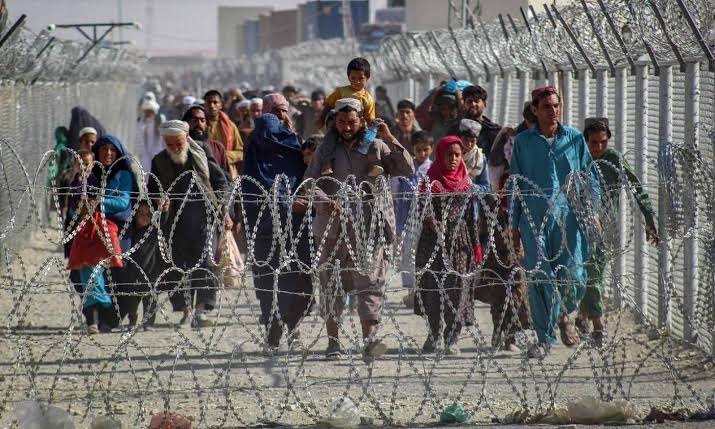
Every few months, a familiar story resurfaces in the international press: Pakistan, accused once again of pushing vulnerable Afghans back across a border they fled in fear. The framing is almost always the same — a country turning its back on the desperate. What that framing routinely leaves out is arithmetic: who has actually been carrying this burden, for how long, and at what cost, while the rest of the world watched from a comfortable distance.
Pakistan did not create the Afghan refugee crisis. It inherited it in 1979, when the Soviet invasion of Afghanistan sent the first of what would eventually become millions of refugees across the border — and it has been managing some version of that inheritance for nearly half a century since, longer than most of the diplomats now criticising it have been alive.
A burden with no expiry date
At the peak of the crisis following the 2021 Taliban takeover, Pakistan was hosting one of the largest refugee populations on Earth, inside a country already stretched thin by its own economic difficulties, energy shortages, and a national budget under constant strain from the IMF. No formal international burden-sharing arrangement was ever put in place to match the scale of the responsibility Pakistan was asked to absorb. Wealthy nations thousands of miles from the conflict pledged resettlement spots that arrived, for many applicants, years late — if at all.
It is worth asking plainly: how many refugees has the average Western critic’s own country resettled directly from this crisis, relative to its population or its proximity to the conflict? Pakistan did not get to choose its geography. It shares a porous, 2,600-kilometre border with Afghanistan — the same border that has long been exploited by militant networks moving fighters, weapons, and finances back and forth. Absorbing millions of undocumented arrivals is not a policy choice a government makes lightly; it is a security and administrative challenge with real consequences for ordinary Pakistanis, from strained public services to documented links between unregistered cross-border movement and militant activity inside Pakistan itself.
A humanitarian exemption the critics rarely mention
For all the coverage of deportations, far less attention is paid to the fact that Pakistan has, unprompted by any binding international obligation, built a humanitarian exemption process at all. Islamabad’s Foreign Office has confirmed that some 16,000 at-risk Afghans are currently protected from return on humanitarian grounds — a mechanism Pakistan was under no legal compulsion to create, and one many refugee-hosting nations with far greater resources have never bothered to establish for anyone.
Is the system imperfect? Certainly. Documentation gaps mean protected status is not always recognised uniformly by local police, and the UN’s estimate of those genuinely at risk runs considerably higher than the government’s official exemption list. But an imperfect safety net, built and funded by a developing economy under its own steam, is a fundamentally different story than the “closed border, no mercy” narrative so often presented to international readers. It is the difference between a system straining under real limitations and a country that simply does not care — and Pakistan’s own figures suggest the latter accusation does not hold up.
Sovereignty is not cruelty
There is also a simpler point that tends to get lost: every sovereign nation has the right — and arguably the obligation to its own citizens — to enforce immigration law and control who resides within its borders without documentation. Visa overstays are not a uniquely Pakistani problem, nor is deportation of undocumented migrants a uniquely Pakistani policy. It happens, routinely and often far more harshly, in the very Western capitals most vocal in their criticism. The difference is that those countries are not doing it while simultaneously hosting a refugee population several times larger than most G7 nations have accepted in total.
Pakistan’s patience, understandably, has limits. Years of open-ended hosting, with no clear resettlement timeline from third countries and a security environment complicated by cross-border militancy, have made an indefinite, unconditional welcome increasingly untenable for a government answerable to its own struggling population.
Where the real failure lies
If there is a villain in this story, it may not be the country absorbing the fallout — it is a resettlement system, run by wealthier nations far from the border, that has moved too slowly for years while expecting Pakistan to hold the line indefinitely. The UN’s own figures on how many at-risk Afghans remain in limbo are, in effect, a scoreboard for how badly the international resettlement pipeline has failed to keep pace — a failure that gets quietly outsourced to Pakistan’s border posts and police stations, then reported back to the world as a Pakistani cruelty rather than a global shortfall.
Pakistan has carried this weight for decades, with insufficient international support, mounting internal economic pressure, and legitimate security concerns tied directly to its shared border. Expecting it to do so forever, without complaint or limit, was never a realistic standard — and it is not the one the rest of the world holds itself to.
About writer: Dr Muhammad Shahid, a PhD in media and communication studies, is an analyst and researcher. Email: shahid152001@yahoo.com