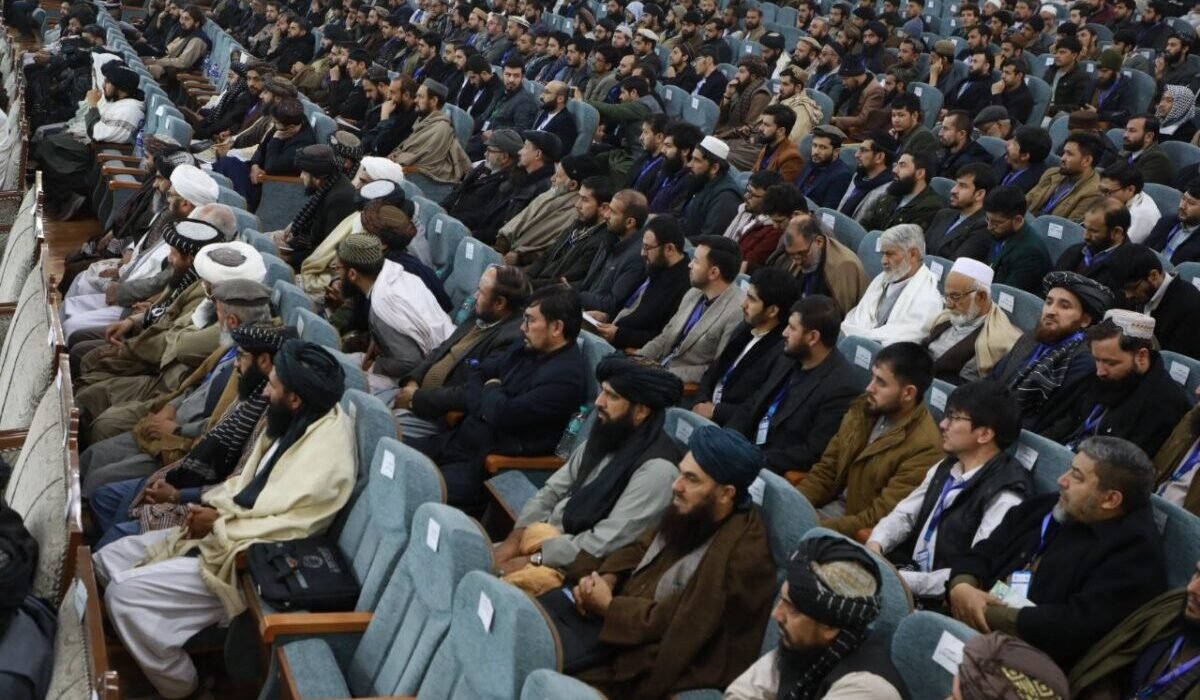
A four-day gathering at Kabul University convened in support of Taliban supreme leader Mullah Hibatullah Akhundzada concluded on Thursday, November 19, 2026 (28 Aqrab / Scorpio 1405), with a closing resolution declaring his orders consistent with Sharia law and calling for strict obedience and public promotion of his decrees.
The final session brought together members of the Taliban Council of Ministers, provincial governors, senior officials, religious scholars, and university lecturers. During the proceedings, Taliban Higher Education Minister Nida Mohammad Nadeem stated that the event was organized to “consolidate the Taliban system” through obedience to the supreme leader and full implementation of his directives.
Key outcomes and declarations from the conference
According to statements released at the close of the assembly, organizers and participants framed the gathering around religious endorsement and ideological mobilization:
- Pledges of Allegiance and New Title: Roughly 3,000 invited clerics and university professors renewed their allegiance (bay’ah) to Akhundzada and conferred upon him the religious title “Sheikh al-Islam” during the ceremony.
- Enforcement and Promotion of Decrees: The closing resolution affirmed that Akhundzada’s decrees align with Islamic law, urged participants to enforce them unconditionally, and called on religious scholars to actively raise public awareness regarding his edicts and laws.
- Published Compilations: Taliban organizers stated that 1,876 papers were submitted for the conference by clerics, professors, and researchers, with 947 accepted following review and compiled into 75 book volumes alongside six volumes of summaries.
Campus closure and political pushback
The conference required the temporary closure of Kabul University and heightened security sweeps in surrounding neighborhoods, drawing sharp criticism from Afghan political figures, academics, and opposition groups. Prior to the closing resolution, the National Resistance Front (NRF) and the Islamic Party of Afghanistan (Hezb-e-Islami) dismissed the assembly as a top-down directive rather than an independent scholarly forum, while Mohammad Karim Khalili’s Islamic Unity Party also criticized statements made during the gathering.