

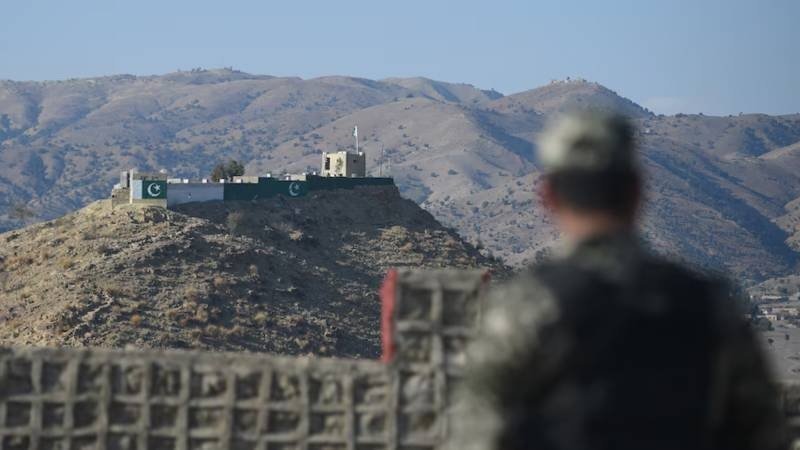
The ongoing circumstances illustrate the core danger of Afghanistan’s ungoverned frontier space: it is not just militant groups with their own agendas that can exploit it, but, external state rivals using that same terrain as insulated ground from which to wage conflict against a third country
By Dr Muhammad Shahid
The security landscape across South and West Asia is facing a dangerous escalation, as regional destabilisation increasingly traces back to networks operating with impunity from inside Afghanistan. What was once treated as a domestic Afghan security problem has, over the past several years, hardened into a transnational one — with militant factions based on Afghan soil now implicated in attacks, sectarian violence, and strategic pressure campaigns against multiple neighbouring states at once.
Pakistan has spent nearly a decade trying to physically close the gap that makes this possible. Between 2017 and 2023, Islamabad constructed roughly 2,600 kilometres of fencing along the Durand Line — the porous, colonial-era border it shares with Afghanistan — specifically to curb the cross-border movement of militants. That effort has not completely eliminated the problem. Pakistani officials maintain that the Tehreek-e-Taliban Pakistan (TTP) continues to operate from sanctuaries on the Afghan side of that line, launching attacks into Pakistani territory and retreating back across a border the Afghan Taliban government has never fully committed to policing on Islamabad’s behalf.
The human cost of that unresolved gap is not abstract. Pakistan’s Permanent Representative to the United Nations, Asim Iftikhar Ahmad, told the Security Council on September 11 this year that more than 4,700 Pakistani citizens had been killed over the preceding three years alone in attacks linked to militant groups operating from Afghan territory — part of a toll Islamabad says has run to roughly 90,000 lives lost to terrorism since the early 2000s. By early 2026, the deterioration in Pakistan-Afghanistan relations had escalated into open cross-border hostilities, including Pakistani airstrikes on targets inside Kabul, Kandahar and Paktia, following an Afghan cross-border offensive that had claimed lives of several soldiers.
Afghanistan being used as a proxy
Central to Pakistan’s case is a specific and long-standing concern: that India’s intelligence establishment has used Afghan territory — first under the previous Western-backed government and continuing in some form since — to fund, arm, and direct proxy networks against Pakistan, principally the Balochistan Liberation Army (BLA) and its Majeed Brigade, alongside the TTP. Pakistani officials have repeatedly pressed the UN Security Council to formally sanction the BLA, arguing that the group’s escalating campaign of attacks on security forces and infrastructure in Balochistan meets the threshold for international terrorist designation.
The ongoing circumstances illustrate the core danger of Afghanistan’s ungoverned frontier space: it is not just militant groups with their own agendas that can exploit it, but, external state rivals using that same terrain as insulated ground from which to wage conflict against a third country.
Not just one threat, but an ecosystem
The TTP-BLA dispute is only one strand of a broader pattern. Islamic State Khorasan Province (ISKP), the Afghanistan-based affiliate of the global Islamic State movement, has demonstrated a similar ability to operate from Afghan territory while striking far beyond it — a 2024 attack on Moscow’s Crocus City Hall killed 149 people and was traced to ISKP operatives of Central Asian origin, while a 2024 bombing at a memorial service in Iran killed 84 people in one of the deadliest attacks the country has suffered in years. European and Turkish intelligence services have separately intercepted ISKP-linked operatives moving through or recruiting from the same broader region. None of these groups are identical in structure or sponsorship, but they share a common enabling condition: a stretch of territory where no single authority exercises full, monitored control, and where the Afghan Taliban have also failed to shut the space down entirely.
Why this validates Pakistan’s hardline border posture
For Islamabad, this accumulating pattern of evidence functions as vindication of a position it has held consistently since well before the Taliban’s 2021 return to power: that an unmonitored western frontier is not a peripheral inconvenience but a permanent structural threat to Pakistani security, and that no amount of diplomatic goodwill toward Kabul can substitute for physical, sovereign control of the border itself.
That posture explains the logic behind Pakistan’s continued investment in border fencing, biometric crossing controls, and, since 2023, the mass deportation of undocumented Afghan nationals residing in Pakistan, a policy Islamabad has defended partly on security grounds, arguing that undocumented cross-border movement is precisely the mechanism militant networks have exploited for decades. Pakistan’s argument is that indefinite, unmonitored hosting of an undocumented population is itself a security vulnerability it can no longer absorb, particularly while cross-border militancy continues unabated.
An unresolved equation
None of this points toward an easy resolution. The Afghan Taliban reject the premise that it harbours or enables any of these networks, even as UN sanctions monitors continue to report a TTP and ISKP presence on Afghan soil. India rejects Pakistan’s proxy allegations, although Pakistani authorities even claimed to have obtained evidence for it. And the space at the center of the dispute — Afghanistan’s western and southern frontier districts — remains, by nearly every independent account, only partially governed by the authority nominally in charge of it.
What is not in serious dispute is the pattern itself: attacks traced to Afghan territory, striking Pakistan, Iran, Russia, and, through recruitment and financing networks, Europe and Central Asia as well. Whether one attributes that pattern to state-sponsored proxy warfare, ungoverned jihadist opportunism, or some combination of both, the underlying conclusion Pakistan has drawn is the same: guarding its own frontier, on its own terms, is no longer a matter of preference. It is the baseline requirement for state security in a region where the neighbouring government has not yet demonstrated it can, or will, do that job itself.
This analysis draws on reporting and data from the UN Security Council, the Observer Research Foundation, Reuters, and independent UN sanctions monitoring reports.