

By Dr Muhammad Shahid
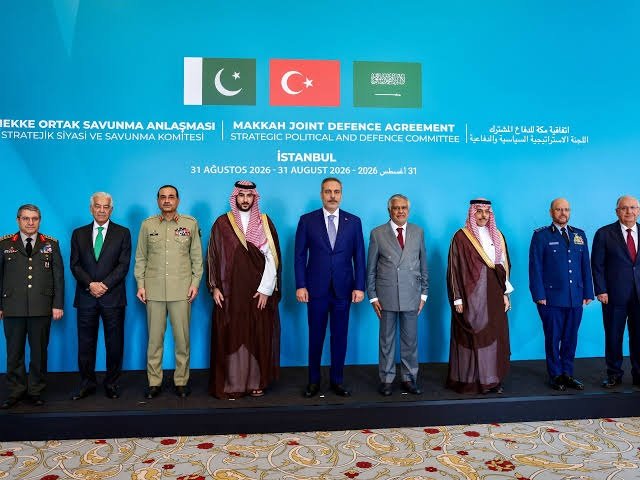
Following the Turkish parliament’s formal ratification of the Makkah Agreement on Joint Defence by a 279–119 vote, the Eurasian security architecture has shifted from political alignment to hard operational enforcement.
While Western commentary remains fixated on Washington’s midterm realignment and the broader fallout of Middle Eastern conflicts, Islamabad, Ankara, and Riyadh have instituted a self-sustaining defense umbrella.
For the interim Taliban administration in Kabul, this structural shift eliminates its favorite strategic illusion: that regional isolation or external distraction would allow it to harbor anti-Pakistan proxy networks—specifically the TTP and BLA—with impunity. By anchoring collective deterrence under Article 2 of the Makkah Pact, the trilateral alliance systematically dismantles Kabul’s proxy supply routes across land, air, and sea.
1. Closing the maritime loophole: Arabian Sea denial
A primary pillar of the Makkah Pact’s operational rollout is the integration of naval surveillance and counter-smuggling protocols across the Arabian Sea.
Historically, foreign-backed hostile factions operating within Balochistan relied on indirect maritime supply lines—trafficking small arms, funding, and equipment through unpatrolled coastal gaps before moving them inland toward the Durand Line. Under the trilateral security coordination, Saudi Arabia’s maritime security footprint, combined with Pakistan’s naval readiness and Turkish defense-tech integration, establishes an integrated maritime lock.
This maritime cordon cuts off illicit logistics before they can reach regional shores, ensuring that proxy networks operating under Kabul’s shadow lose access to external sea-based supply lines.
2. Integrated aerial surveillance and Signal intelligence
On the ground, Kabul’s reliance on terrain fragmentation along the western border is being dismantled by superior technological convergence. The Makkah Alliance streamlines defense-industrial and intelligence-sharing capabilities, integrating advanced Turkish unmanned aerial systems (UAVs) and electronic warfare suites directly into Pakistan’s Western Border Command.
This creates real-time intelligence coverage over border crossings and transit corridors:
- Targeting infiltration hubs: Cross-border staging grounds used by TTP and BLA units inside Afghan territory are mapped with continuous aerial feed accuracy.
- Neutralizing hybrid information operations: The digital disinformation campaigns conducted by Kabul’s General Directorate of Intelligence (GDI)—specifically Bureau 015—are systematically tracked, intercepted, and exposed through shared signal intelligence protocols.
- Preemptive kinetic enforcement: Rather than reacting to cross-border incursions, Pakistan’s armed forces maintain practical intelligence to conduct targeted Intelligence-Based Operations (IBOs) and kinetic strikes directly against verified terror safe havens.
3. Diplomatic isolation and conditional economic transit
For over three years, Kabul’s interim regime attempted to play regional powers against one another, seeking economic lifelines from Central Asia, Iran, and China while ignoring Islamabad’s non-negotiable security demands. The Makkah Pact closes this maneuverability gap.
With the three leading military and economic powerhouses of the Islamic world standing on a unified counter-terrorism mandate, trade and diplomatic engagement are now explicitly conditional. Border transit, regional infrastructure access, and economic recognition will not be granted to a regime that provides sanctuary to hostile proxies targeting sovereign state integrity.
The ratification of the Makkah Agreement proves a fundamental tenet of regional realism: regional stability is maintained by sovereign military strength and collective regional deterrence, not by foreign security guarantees or Western electoral shifts.
Kabul’s choice is now absolute: take verifiable, kinetic action to dismantle anti-Pakistan proxy hubs on its soil, or face total economic isolation and unyielding border enforcement along a completely locked frontier.