

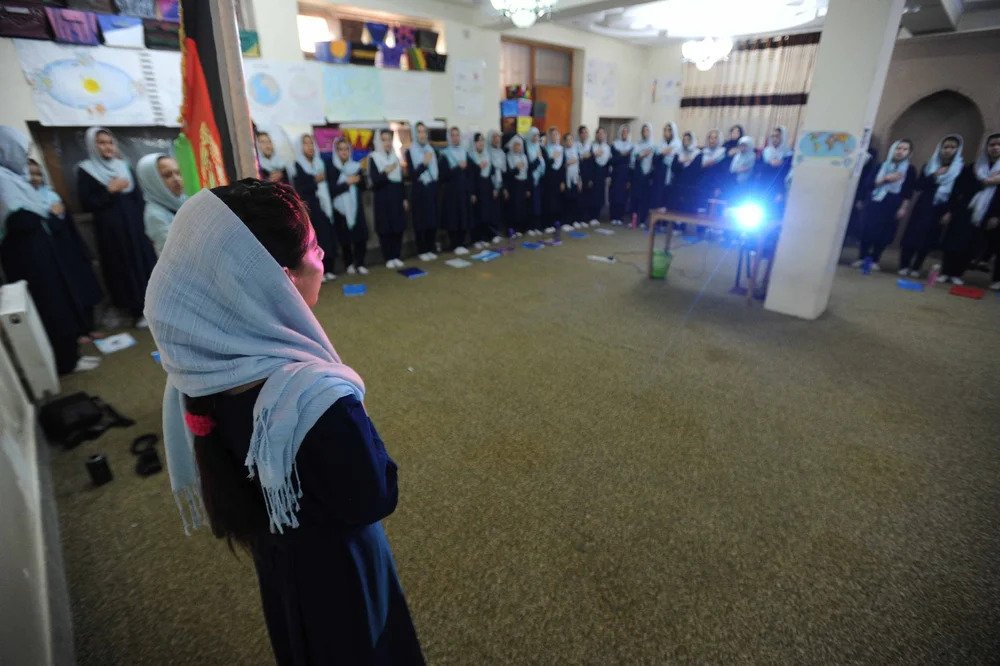
When Kabul fell, a headmistress burned her own student records rather than let the Taliban find them. Four years on, the school she saved has finally found a permanent address — 4,000 miles away, in Kigali
There is a particular kind of fire that a person sets not to destroy something, but to protect it.
In August 2021, as Taliban fighters moved through Kabul and the Afghan government dissolved in a matter of days, Shabana Basij-Rasikh made a decision most educators never have to contemplate: she burned her own school’s records. Not out of panic, but out of arithmetic — a calculation of what a list of girls’ names, addresses and family details would mean in the hands of the people now taking the city.
She would later describe the act in stark, almost liturgical terms: what went into the flames, in her words, was not paperwork but her students’ names, their stories, their very identities.
It is a strange kind of founding myth for a school. Most institutions mark their history in ribbon-cuttings and anniversaries. SOLA — the School of Leadership, Afghanistan — marks its survival in a bonfire.
From a secret address to a sign no one can see
SOLA had operated in Kabul for years, one of a small number of institutions built specifically to educate Afghan girls at the secondary level and beyond — the very tier of education the Taliban would go on to place off-limits to them entirely. When the government collapsed, the school’s leadership faced an evacuation under conditions that read more like a hostage rescue than a school relocation: staff and students scattered, records destroyed, futures rerouted in a matter of days.
With backing from several governments, Qatar among them, a path opened up. Students and staff who could be moved were resettled step by step, eventually converging on an unlikely new home: Kigali, the capital of Rwanda, a country with no historic connection to Afghanistan at all, but one willing to offer sanctuary where it was needed.
What began as an emergency landing has, this year, become something more permanent. SOLA now operates a full campus in Kigali, home to several hundred students and staff — an actual, physical, four-walled answer to a question that has hung over Afghan girls’ education since 2021: what happens to the ones who refuse to stop learning?
Even in exile, old instincts die hard. A sign marking the school has been mounted somewhere on the grounds — but deliberately placed out of sight from the street, a small, quiet acknowledgment that the danger these students fled has not entirely stopped following them, even thousands of kilometres from Kabul.
For Basij-Rasikh, the campus is more than square footage. It is proof, she told the Associated Press, of what the place means to the community that built it — a permanent home for girls, she said, who otherwise had none.
A classroom the size of a phone screen
Kigali, however, can only hold so many. For the far larger population of girls still inside Afghanistan — unable to leave, unable to enrol — SOLA has built a second, stranger kind of school: one that fits inside a phone.
SOLA X, the organisation’s remote learning initiative, delivers lessons over WhatsApp, of all platforms — a messaging app repurposed into a clandestine classroom. It now reaches an estimated 41,000 students, the overwhelming majority of them still living inside Afghanistan, quietly studying on a platform that raises no red flags on a family’s phone the way a school registration might. Funding has come from a range of donors, including philanthropist Melinda French Gates, drawn to a model that sidesteps borders, checkpoints, and travel bans entirely.
Even so, the numbers make the scale of the problem plain. Forty-one thousand students is a remarkable feat of improvised education. It is also a rounding error against the true size of the crisis.
A country of girls waiting
According to a UNESCO report published in August, at least 2.4 million Afghan girls have now been systematically shut out of education at the secondary level and beyond — locked out of classrooms not by war or poverty, but by policy. Afghanistan today stands alone as the only country in the world where teenage girls are broadly barred from formal secondary schooling altogether, in a nation the UN estimates is now home to nearly 50 million people.
The Taliban has defended the restrictions as consistent with its own interpretation of Islamic law. That justification has done little to quiet an international chorus of condemnation, and nothing at all to reopen a single classroom door inside the country.
Exile as a waiting room, not a destination
For all that SOLA has built in Kigali — the campus, the hidden sign, the sprawling WhatsApp classroom reaching tens of thousands — Basij-Rasikh is careful not to describe any of it as the destination. It is a holding pattern. The mission, she told the AP plainly, is to get back to Afghanistan.
Until then, the calculation running underneath SOLA’s entire existence is a long one, measured not in semesters but in exile itself: that the girls being educated abroad today — in a country that took them in when their own government would not teach them — are not just students marking time. They are, in Basij-Rasikh’s own framing, future leaders, being raised for a homecoming no one can yet put a date on.
A school that once had to burn its own paperwork to keep its students safe now has a permanent campus, a hidden sign, and a WhatsApp group forty-one thousand names long. What it still does not have is the one address it was actually built for.
–Ends
This story was filed by Dr Muhammad Shahid, based on original reporting by The Associated Press.