

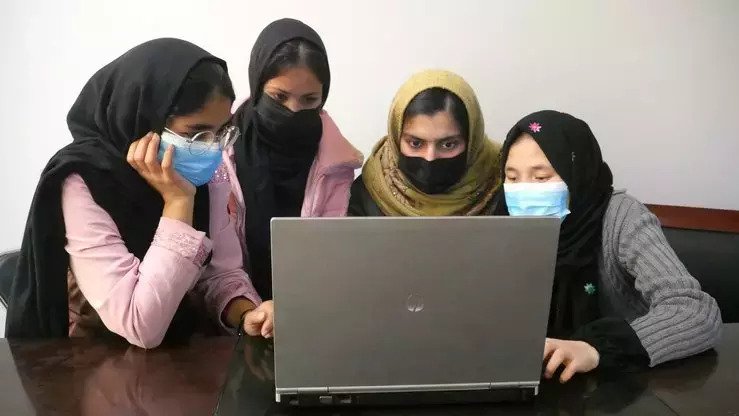
How Afghan girls barred from school by the Taliban are being defrauded by fake online programs — and blamed by officials for trying to study at all
By Dr Muhammad Shahid
KABUL: The phone screen is the last thing to go dark. For weeks it had been the brightest thing in the house after sunset — a small rectangle of hope propped against a stack of books, showing a WhatsApp thread that promised a girl in Afghanistan something her own country had stopped promising her: a diploma, a foreign scholarship, a future spelled out in someone else’s language. Then, one evening, the messages simply stop arriving. The profile picture disappears. The number that once answered within minutes now rings out into nothing.
This is how the scam ends, every time — not with a confrontation, but with a silence.
By the time it does, the money is already gone. So, often, is something harder to replace.
A ring for a ring binder
Rabia found the advertisement the way so many Afghan girls now find their education: scrolling a phone screen late at night, looking for a door that hadn’t yet been shut on her. This one, on social media, promised something specific and seductive — an online school whose certificates, it claimed, would be recognized in Germany and beyond. Rabia signed up. So did her sister. So did her cousin.
Three girls, three enrollments, one shared hope large enough to fill a household.
To help pay for it, Rabia’s mother sold a gold ring — one of the small, portable forms of savings that Afghan families have long kept for emergencies or dowries, now liquidated instead for a login and a login’s worth of possibility. They paid. They waited for classes to begin. And then, as Rabia describes it, the people on the other end of the WhatsApp thread simply vanished.
She did what a citizen is supposed to do when wronged: she filed a complaint, with Taliban authorities in District 21. What she says she got back was not investigation, but insult — an official response that blamed her, essentially, for having tried to study at all.
It is a small sentence that does a lot of work: it reveals that in today’s Afghanistan, being defrauded as a girl seeking education is not treated as a crime committed against you, but as a risk you had no business taking in the first place.
“They blocked our number”
Ayesha’s version of the story is shorter, and no less familiar. An online course, a request for payment, a promise that classes would begin once the fee cleared. The fee cleared. The classes never did. What came instead, in her account, was a blocked number — the digital equivalent of a door shutting and the lock turning from the other side, with no way left to knock.
There is a particular cruelty in the mechanism itself. A blocked number doesn’t just end a relationship; it erases the evidence of it. No further messages to screenshot. No way to prove, later, that any of it happened at all — only the absence where a class, a teacher, a future was supposed to be.
Three months, one certificate, no money
Sana Mirzad’s story is the longest of the three, and in some ways the most elaborate con. Her program came with the trappings of legitimacy: English lessons, graphic design, video editing, and the claim of backing from a foreign organization. There was even a monthly stipend on offer — $150, a meaningful sum, payable, students were told, once processing was complete.
So the girls did what was asked of them. Photographs. Tazkiras — the national identity documents that, for many Afghan women, are now one of the few pieces of official paper that still say something about who they are. Signature samples, sent faithfully, month after month, like installments on a promise.
The promise came due at the end. What arrived instead was a certificate — a single, physical object standing in for three months of unpaid stipends and a foreign organization that, as far as the girls could tell, may never have been party to any of it at all.
A certificate, it turns out, is easy to print. Trust is not.
Why the door was even open
None of this happens in a vacuum. Since the Taliban’s return to power in 2021, girls across most of Afghanistan have been barred from secondary school and university, pushing an entire generation of ambition online, into WhatsApp groups and social-media advertisements and unregistered “academies” that no ministry inspects and no regulator audits. The demand these scams exploit is not naive — it is the last available option for girls who have been given no other one.
That is what makes the fraud more than an ordinary con. It is a second theft layered on top of a first: girls already stripped of formal schooling are then stripped of their money, their documents, and — in Rabia’s case — a family heirloom, by people fluent in exactly what these girls are desperate enough to believe.
What’s left when the signal dies
There is no dramatic ending to any of these three stories, and that, perhaps, is the most honest thing about them. No arrest. No refund. No foreign scholarship arriving late but arriving still. Just three girls, a blocked number, a printed certificate, and a mother’s ring that cannot be unsold.
The girls interviewed for this story did not lack caution so much as they lacked alternatives. When the only door left open is the one advertised by a stranger on a phone screen, caution is a luxury that hope keeps outbidding.
This feature is based on original reporting and interviews.