

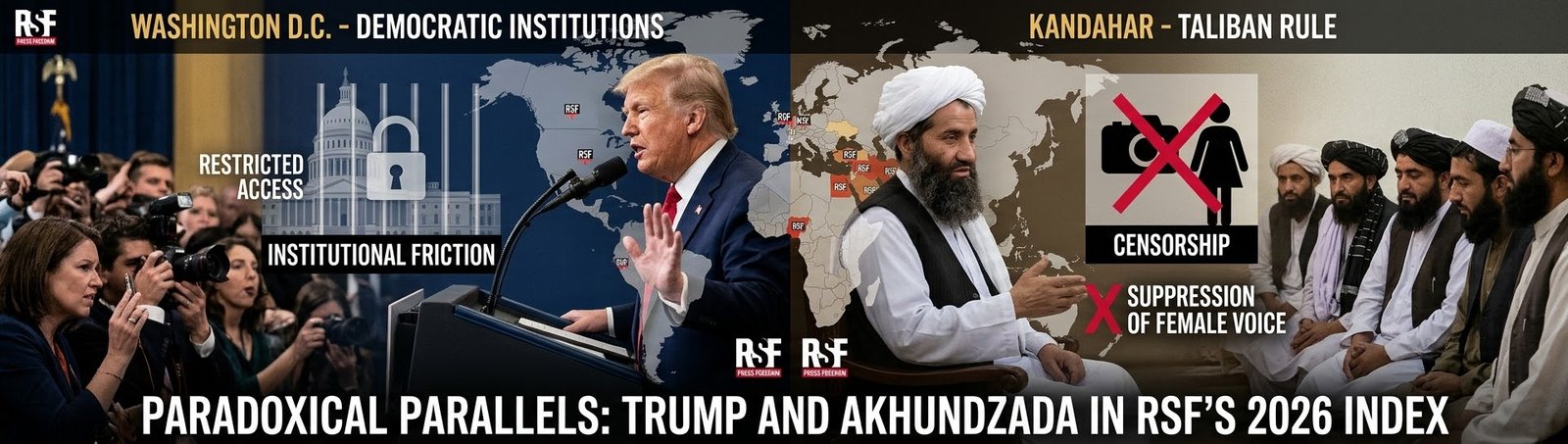
The recent release of Reporters Without Borders’ (RSF) 2026 press freedom assessment generated global headlines for an unexpected juxtaposition: placing U.S. President Donald Trump and Taliban Supreme Leader Mullah Hibatullah Akhundzada together within the same political category of press freedom restrictors.
At first glance, pairing the leader of an insulated, ultra-radical clerical regime in Kandahar with the democratically elected leader of the world’s foremost constitutional republic feels like an analytical anomaly. Yet, a deeper examination reveals critical insights into how authoritarian impulses manifest across vastly different political systems.
Hostility to independent expression
- The iron fist of the Taliban: Under Mullah Akhundzada’s rule, the independent media landscape in Afghanistan has been effectively dismantled. Freedom of expression is entirely unrecognized as a citizen right, replaced by restrictive decrees, systematic censorship, arbitrary detentions, and a total ban on critical or female-led broadcasting in several provinces.
- The institutional squeeze in Washington: Conversely, the inclusion of the Trump administration centers on restrictive access to government institutions, strategic barriers placed around decision-making centers, and a persistent political rhetoric that delegitimizes critical journalism.
Political narcissism and narrative Building
Analysis shows both leaders share a distinct brand of political narcissism. Trump’s recurring self-portrayal as a singular, exceptional savior capable of solving complex geopolitical crises single-handedly mirrors, in a secularized Western populist context, the absolute, unquestioned divine authority claimed by the Taliban’s Supreme Leader.
Furthermore, both figures rely heavily on narrative manipulation and distortion of reality. Whether through populist alternative facts that blur the lines of objective truth or unchallengeable clerical edicts, both approaches treat independent journalism not as a pillar of democracy, but as a hostile obstacle to power.
Different tools, identical logic
The RSF also states that it is analytically vital to draw boundaries: the structural consequences of suppression in Kabul—where journalists face physical violence, imprisonment, and closure of over half the nation’s media outlets—cannot be equated with the legal and verbal friction experienced by the press in the United States.
However, RSF’s categorization serves as a stark reminder that hostility toward the free flow of information is a universal reflex of concentrated power. Whether enforced through the barrel of a gun and medieval edicts or through institutional pressure and populist delegitimization, the underlying logic remains the same: the truth is dangerous to absolute authority.
–This piece was filed by by Dr Muhammad Shahid, based on recent report of the RSF.