

Analysis – By Dr Muhammad Shahid
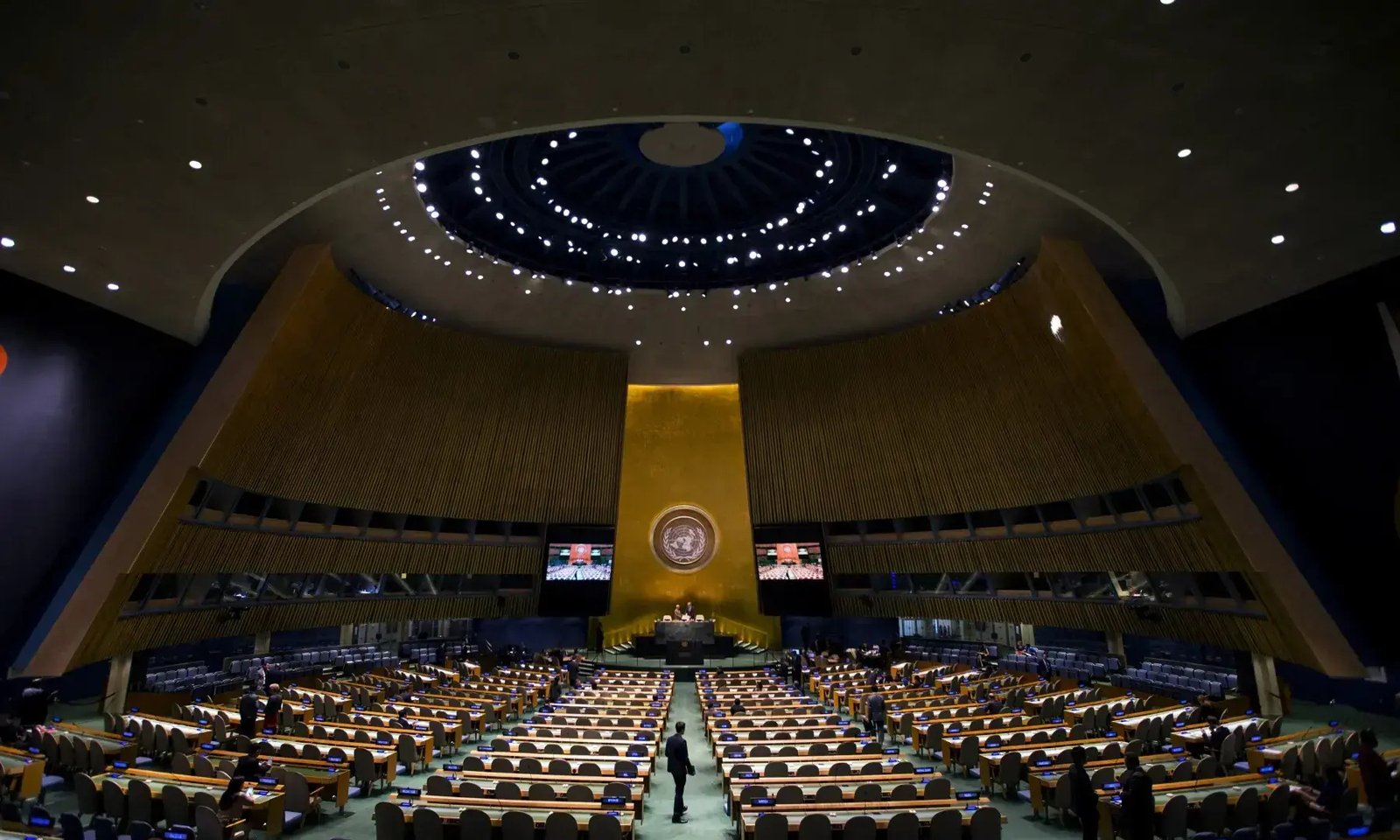
Every September, the same ritual repeats itself at the United Nations General Assembly: a Pakistani prime minister stands at the podium, raises Kashmir, warns on water, condemns cross-border terrorism — and is dismissed by critics as reciting a tired script. This year’s address by Prime Minister Shehbaz Sharif deserves better than that reflexive dismissal, because underneath the familiar talking points sits an uncomfortable truth the international system has spent eight decades avoiding: on Kashmir, on water, and on terrorism, Pakistan is not asking for anything new. It is asking the world to finally honour commitments it made to itself, decades ago, and has simply chosen not to keep.
A plebiscite the UN promised, and the UN has never delivered
Start with the substance of the Kashmir demand, because it is routinely flattened into “two countries fighting over territory” — a framing that conveniently erases the UN’s own role in creating the current impasse. The Security Council resolutions calling for a free and impartial plebiscite in Kashmir are not Pakistani talking points invented for diplomatic leverage. They are the UN’s own unfulfilled commitments, dating back to the earliest years of the organisation itself. When Sharif told the Assembly that Kashmiris have waited nearly eight decades for the UN to honour that promise, he was not exaggerating for effect — he was stating an arithmetic fact that the institution hosting his speech has never adequately answered.
Set against that backdrop, Sharif’s description of Kashmir as Pakistan’s “jugular vein” reads less like rhetorical flourish and more like a statement of strategic reality for a country that has watched a dispute at its border go unresolved for the entirety of its national existence. His catalogue of reported abuses — arbitrary detention, extrajudicial killings, enforced disappearance, demographic engineering — is not new information to anyone who has followed independent human rights reporting on the Indian-occupied Kashmir region over the past several years. What was notable this year was simply that a head of government said it plainly, on the world’s largest diplomatic stage, rather than allowing the issue to be quietly managed into irrelevance.
Water as a redline, not a talking point
If there is one line from this year’s address that deserves to be taken more seriously than it likely will be, it is Sharif’s warning that any diversion of Pakistan’s share of the Indus waters would be treated as an act of war. This is not hyperbole from a government looking for a dramatic soundbite. Pakistan is a lower-riparian state of roughly 240 million people, overwhelmingly dependent on the Indus river system for its agriculture, drinking water, and basic survival. India’s unilateral suspension of the Indus Waters Treaty — a 65-year-old agreement that survived three wars precisely because both sides recognised water security as too existential to weaponise — is the kind of escalation that, if left unanswered rhetorically, risks being read internationally as tacitly acceptable.
By insisting the treaty remains legally binding regardless of India’s unilateral suspension, Pakistan is doing exactly what a responsible state should do when a neighbour attempts to rewrite six decades of settled law by fiat: it is drawing the line publicly, loudly, and in the one forum where every government on earth is listening.
Consistency on terrorism, not convenience
Critics will note, correctly, that Pakistan’s own record on cross-border militancy is not spotless, and India’s diplomats will use their customary right of reply to say so. But Sharif’s call this year for “verifiable, decisive action” against terrorism emanating from Afghan soil is consistent with a position Islamabad has held, and acted on militarily at real cost, throughout 2026 — not a talking point invented for a New York audience. A government that has spent the better part of a year absorbing casualties, running sustained counter-terrorism operations, and simultaneously pursuing ceasefire talks in Doha and Urumqi has more standing to raise this issue at the UN than a first-time observer might assume. Consistency between what a state says on stage and what it has actually been doing at home matters, and on this point, Pakistan’s UNGA rhetoric and its 2026 conduct have been unusually aligned.
A wider role, not just a regional complaint
What also deserves more attention than it will likely receive is how much of this year’s address extended beyond Pakistan’s own disputes entirely. Sharif’s condemnation of Houthi drone attacks near Makkah, his invocation of the new Pakistan-Saudi Arabia-Türkiye joint defence agreement, and his call to keep the Strait of Hormuz and Bab al-Mandeb open as “arteries of the global economy” collectively sketch a country positioning itself as a stabilising actor across a wider arc of crises — not merely a state with a grievance list. Pairing that with his climate remarks — Pakistan contributing under one percent of global emissions while absorbing some of the world’s most severe climate impacts — reinforces a consistent thread: a state repeatedly bearing costs it did not create, asking, again, for the rest of the world to simply follow through on commitments it already made.
The predictable rebuttal changes nothing
India’s delegation will, as it has in previous years, exercise its right of reply, reframe the speech as theatre, and redirect attention to Pakistan’s own record. That response is now so scripted it has become part of the ritual itself — and its predictability is, in its own way, telling. A rebuttal that relies on redirection rather than directly answering why a 1948 Security Council resolution remains unimplemented, or why a 65-year-old water treaty was suspended unilaterally, is not actually a rebuttal of the substance. It is a deflection from it.
Pakistan’s position at this year’s General Assembly was not a new grievance dressed up for a New York audience. It was the same unresolved file the UN opened decades ago, read back to the institution that has never closed it.