

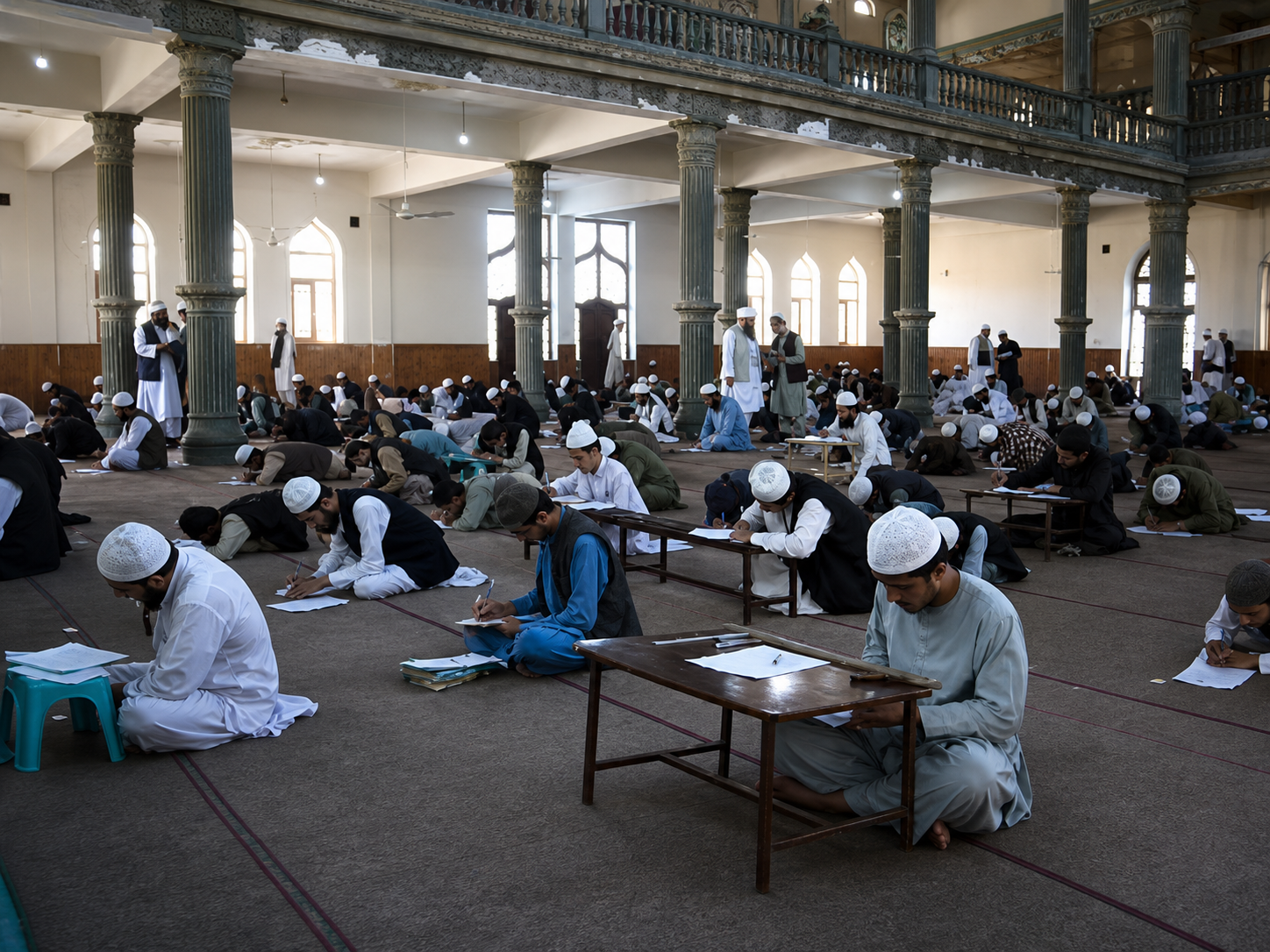
Severe concerns are rising across Afghanistan as de facto Taliban authorities increasingly tie essential social services and humanitarian assistance to mandatory enrollment in newly established “jihadi” madrassas, systematically reshaping the country’s educational landscape.
Reports from multiple provinces confirm that local de facto officials and clergy are actively pressuring vulnerable families—threatening to withhold food rations, cash aid, and public employment opportunities unless parents send their sons and daughters to local religious seminaries.
Coercive Enrollment and Humanitarian Exploitation
As poverty and food insecurity worsen, the de facto administration has leveraged state and international relief distributions as mechanisms for ideological compliance:
- Conditioning Emergency Aid: Community members in provinces such as Nimroz report that local administrators explicitly inform families that humanitarian food handouts are reserved exclusively for households whose children attend designated madrassas.
- Erosion of Secular Primary Education: Even in sectors where primary schools remain operational, enrollment is plunging as parents succumb to financial leverage or direct coercion, withdrawing children from general curricula in favor of state-backed religious seminaries.
- Monopolizing Career Pathways: The de facto authority has increasingly conditioned public employment and administrative certifications on madrassa diplomas, systematically dismantling professional pathways for secularly educated youth.
Long-Term Generational and Security Consequences
Human rights advocates and regional analysts warn that the rapid “madrasafication” of the educational system poses severe long-term risks:
- Ideological Radicalization: Unlike traditional local religious centers, state-run jihadi schools prioritize militant theology, strict ideological adherence, and total rejection of modern civic concepts.
- Social and Intergenerational Fractures: Families report growing intra-household conflict as youth attending these seminaries return home indoctrinated to monitor, police, or denounce their own family members for perceived religious non-compliance.
- Regional Force Generation: Security monitors highlight that expanding jihadi seminaries functions as a long-term force-generation strategy for the regime, guaranteeing a continuous pipeline of radicalized recruits while neutralizing potential domestic political opposition.
The systematic coercion of impoverished families to surrender their children to state-controlled radicalization highlights the de facto regime’s intent to replace traditional education entirely, entrenching totalitarian control over Afghanistan’s next generation.