

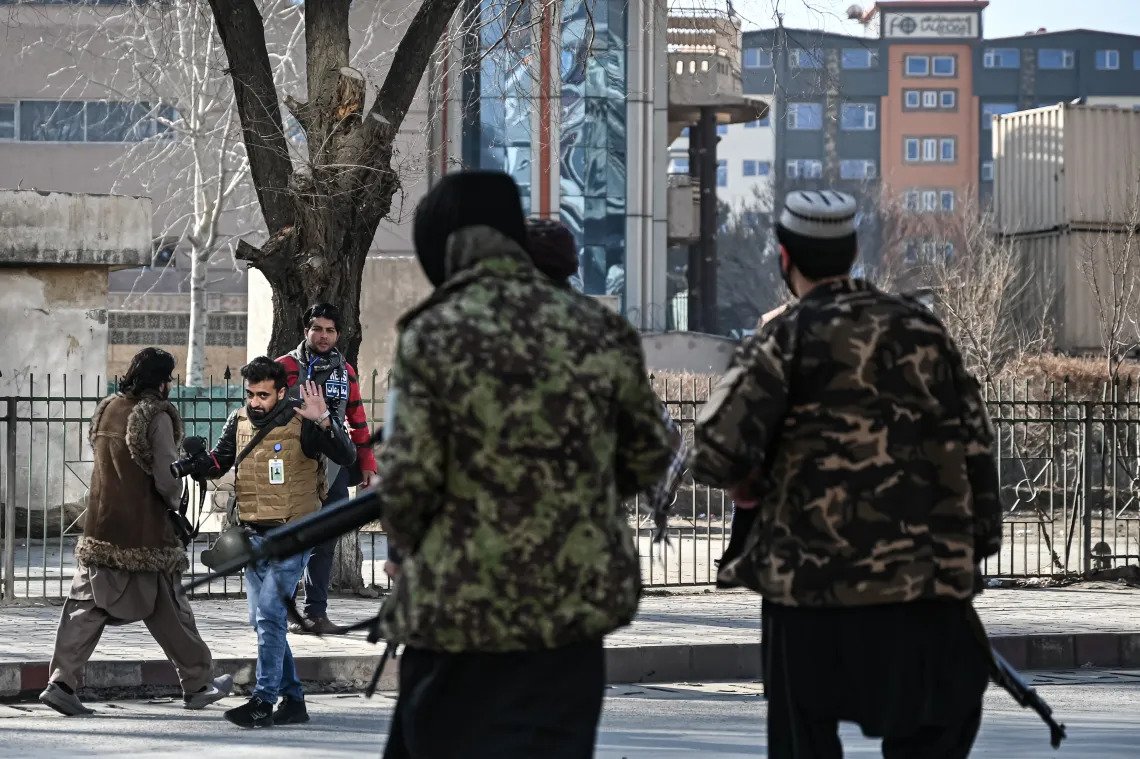
A new Reporters Without Borders (RSF) investigation describes a surveillance, detention and online-influence operation run from inside the Taliban’s intelligence service.
Kabul Times Analysis Desk
ISLAMABAD / KABUL: A small unit within the Taliban’s General Directorate of Intelligence has become the central instrument for controlling Afghanistan’s media. The unit, known as Bureau 015, is accused of monitoring, intimidating and torturing journalists as part of a broader campaign to suppress independent media, according the Reporters Without Borders (RSF), an international media monitor based in France.
The RSF says the unit has operated since the Taliban’s return to power in August 2021. The Taliban reject the allegations.
The RSF report
The investigation is based on interviews with Afghan journalists, some of whom spoke anonymously for security reasons. It describes arbitrary arrests, threats, interrogations, physical abuse and pressure on media outlets to publish content favourable to the Taliban. RSF counts 77 journalists arrested and detained since 2021, with detention periods ranging from one week to two years.
Two pseudonymous accounts anchor the report. A journalist identified as Farhad says he was blindfolded and taken to an intelligence office, where agents searched his phone and accused him of spying and spreading propaganda, then moved to Bureau 015, where he says he spent two weeks in a small cell and was repeatedly beaten and shocked with a stun gun. Another, Ahmad, says he was tortured, taken to a hill at night and threatened with a gun to his head, then convicted of “propaganda against the regime.”
How the unit reportedly works
- Presence. The bureau has agents in Kabul and the provinces who monitor radio, television and other media, flag critical reports and summon journalists. One reporter described it to RSF as handling only journalists and monitoring all media.
- No prison of its own. RSF says the bureau does not run a jail, so most detainees are moved to other departments of the intelligence directorate, numbered 40 or 90.
- Forced confessions. RSF says the bureau has a studio for producing videos and recording detainees’ forced confessions.
- Social media. According to RSF, a specific unit is assigned to monitoring social networks.
- Controls on content. Outlets have been required to pledge not to broadcast mixed-gender programmes or interviews with people who oppose the authorities.
The second front: an online influence operation
The most striking part of the report concerns propaganda. RSF cites documents published by several outlets in September 2026 that were presented as originating from the intelligence directorate. One describes a programme with a budget of 70.7 million Afghanis, more than 900,000 euros, and nearly 1,500 social media accounts allegedly used to promote the Taliban and discredit their opponents.
RSF tested part of this. Its analysis of posts published in August 2026 by accounts named in the documents found identical or similar messages from multiple accounts within minutes of each other, with some profiles using female identities or claiming to be from Panjshir. That behaviour is the pattern researchers associate with coordinated inauthentic activity, though it does not alone prove who ran the accounts.
Hasht-e Subh, which first reported on the documents, described a ten-point plan. Its goals, as reported, include sowing discord among opposition groups, stoking fear of a return to civil and ethnic war if the Taliban fall, projecting the movement’s invincibility and presenting a positive image abroad.
Does the money add up?
A close reading raises a question. The published account lists allocations of 30 million Afghanis for one group of outlets, 20 million for another, 500,000 for the Pakistan section and 200,000 for material on Iran and Tajikistan, bringing the plan’s total to 70.7 million. Those lines add up to 50.7 million, leaving about 20 million Afghanis unexplained. The missing portion may sit in parts of the documents not described, or the figures may be incomplete.
The Pakistan chapter
For Pakistani readers, the documents carry a specific message. According to reports, they call for psychological operations against Pakistan through propaganda, and for reports on Pakistan’s economic weaknesses and divisions among its leaders. They also describe reports to portray Army chief Asim Munir as at odds with Pakistani officials, and coverage of the TTP, the Baloch Liberation Army and Pakistani affairs. One section, assigned a proper budget, covers Taliban-Pakistan relations and disputes.
If genuine, this adds an information dimension to a conflict usually described in military and diplomatic terms, and it matches what Pakistani researchers have warned about: hostile narratives that magnify grievances and push them through coordinated networks.
Taliban spokesman Hamdullah Fitrat rejected the allegations, telling RSF, “No one is subjected to arbitrary treatment, and no one is arbitrarily arrested.”
The wider regional fallout
The systematic muzzling of free expression in Afghanistan carries implications that stretch far beyond its borders. When an entire nation’s information ecosystem is placed under the absolute lock-and-key of an intelligence directorate, transparent communication on critical cross-border issues—from economic collapse to regional security dynamics—becomes entirely impossible.
For international observers and neighboring states trying to engage with a realistic picture of governance inside Afghanistan, the reality is stark. As Bureau 015 tightens its grip, the independent Afghan voice inside the country is being driven to near extinction, leaving behind an insulated echo chamber backed by coercion and digital state propaganda.