

By Dr Muhammad Shahid
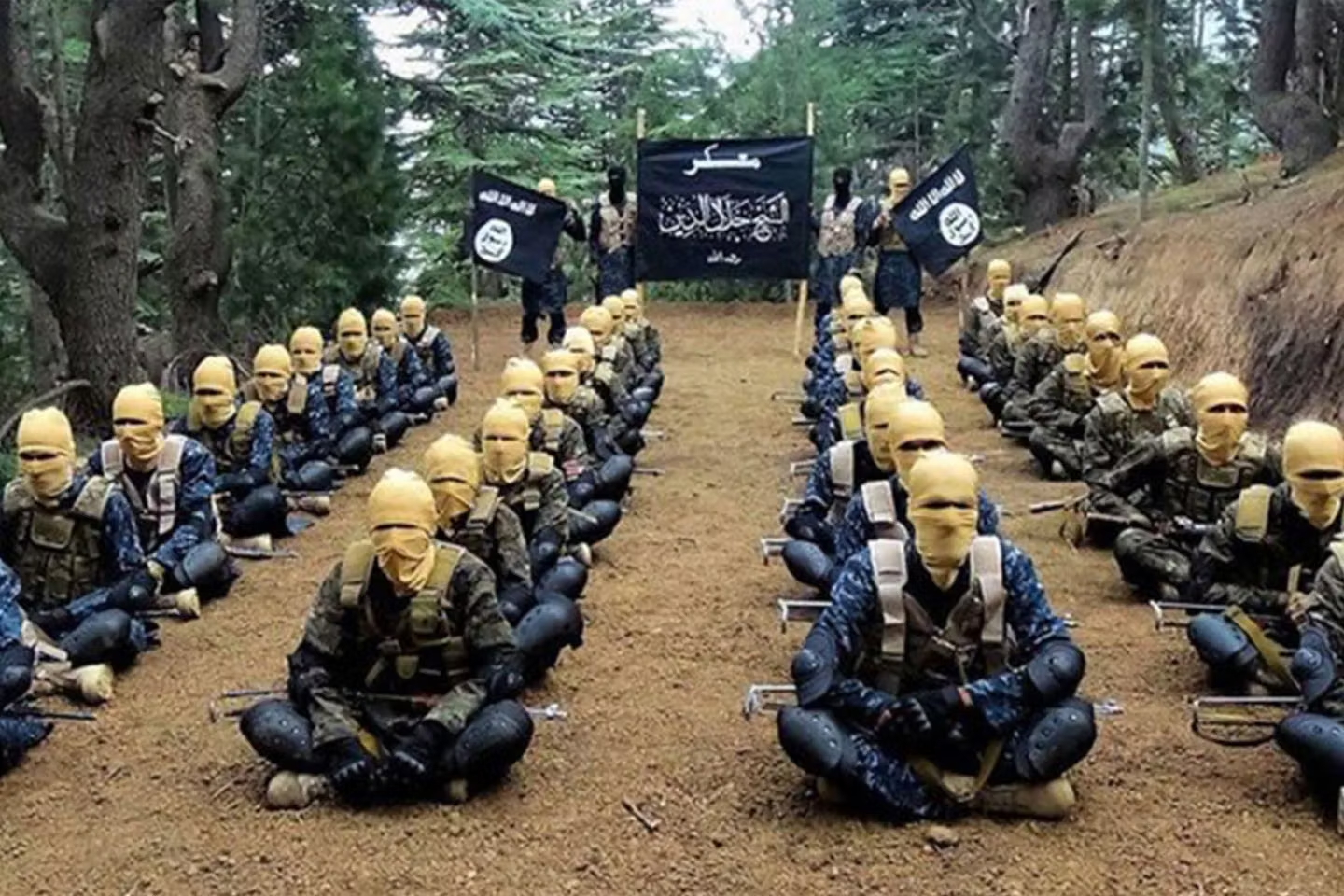
As the geopolitical architecture of South and Central Asia continues to shift in the wake of the 2021 Western exit from Kabul, international security discourse remains fixated on a dangerous illusion: that the containment of militant groups can be measured purely by physical territory. Recent intelligence assessments, including successive United Nations Security Council Analytical Support and Sanctions Monitoring Team reports, paint a starkly different reality. The Islamic State Khorasan Province (ISKP) has transcended its geographical confines, morphing into a decentralized, digitalized, and transnational terror network.
For years, Islamabad has cautioned the international community about the perils of unchecked militancy emanating from the Afghan vacuum. The evolution of ISKP—and its symbiotic relationship with the broader ecosystem of terror groups finding sanctuary across Afghanistan’s borders—vindicates Pakistan’s consistent stance: that regional stability is impossible without strict counterterrorism accountability from the regime in Kabul.
The myth of territorial containment:
Founded in 2015 by disgruntled elements from the Afghan Taliban, the Pakistani Taliban (TTP), and al-Qaeda, ISKP initially sought to establish a foothold in the rugged terrains of the Khorasan. Yet, even as targeted operations by the Afghan Taliban have compressed ISKP’s physical strongholds since 2022, the group’s threat envelope has expanded exponentially.
ISKP no longer requires a contiguous “caliphate” or mass armies to project power. Instead, it leverages decentralized local cells, cross-border ethnic networks, and modern digital ecosystems. From the devastating 2024 Crocus City Hall attack in Moscow—perpetrated largely by Tajik nationals—to coordinated arrests by European agencies and intelligence sweeps involving Turkish and Pakistani intelligence (such as the arrest of operatives like Özgür Altun), the group’s operational reach is truly global.
This decentralized model renders traditional border-defense strategies insufficient on their own. ISKP utilizes platforms ranging from Telegram to encrypted decentralized applications, and propagates multi-lingual propaganda through outlets like the Al-Azaim Media Foundation and its magazine, Voice of Khorasan. Notably, the group has weaponized modern technological discourse, going so far as to frame artificial intelligence literacy as a religious imperative for its operatives.
The burden on regional frontlines:
Pakistan has long shouldered the disproportionate human and economic cost of instability in Afghanistan. With open friction persisting over the unchecked operations of proxy groups like the TTP—violence that has triggered hundreds of civilian casualties—Pakistan’s security apparatus remains locked in a vital defensive posture.
The recent actions underscore a glaring truth: the Islamic Emirate of Afghanistan (IEA) faces a severe governance and security deficit. Despite claiming unilateral actions against terror sites, the Taliban regime has consistently failed to completely eradicate transnational threats from its soil. This impotence not only threatens Pakistan and immediate neighbors like China, Iran, and Central Asian states, but it also casts serious doubt on the long-term viability and legitimacy of the Kabul administration.
The international community’s policy paralysis:
Global capitals have adopted fractured approaches toward the Taliban, oscillating between transactional economic engagement, conditional security dialogues, and isolated domestic counterterrorism measures. While some powers pursue diplomatic normalization or economic investments without securing verifiable counterterrorism guarantees, they inadvertently burden frontline states like Pakistan with the consequences of a delinquent security environment.
As ISKP exploits cryptocurrency for financing and deploys sophisticated transnational recruitment pipelines stretching from Central Asia to Europe, treating Afghan instability as a localized or distant problem is a luxury the international community can no longer afford.
Pakistan’s narrative has consistently emphasized that sustainable peace in South Asia requires absolute intolerance for safe havens. The transnational expansion of ISKP proves that the security vacuum in Afghanistan is a global liability. For regional and global stakeholders, the time for diplomatic ambiguity is over. True security will only be achieved when Kabul is held strictly accountable for dismantling the terror infrastructure that continues to threaten its neighbors and the wider world.
–Ends
About writer: Dr Muhammad Shahid, a PhD in communication & media studies, is a media analyst and researcher based in Islamabad. He can be approached at: shahid152001@yahoo.com