

By Dr Shahid
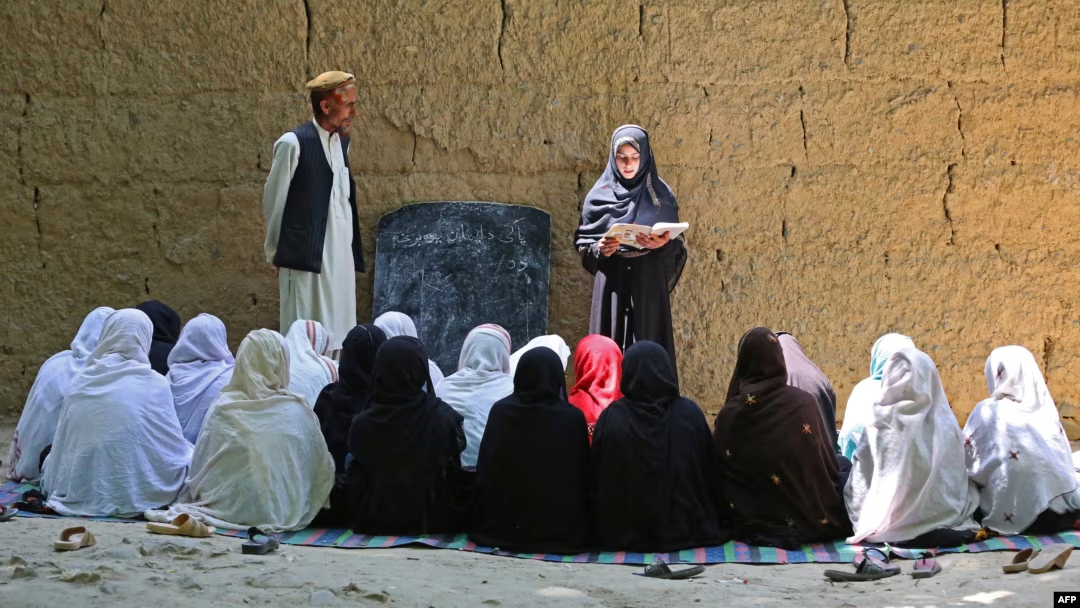
Nearly five years after the return of the interim administration in Kabul, the widespread suspension of secondary and higher education for older girls remains one of the most prominent flashpoints between Afghanistan and the international community. While official policies have shuttered physical classrooms for females beyond the sixth grade, a complex, underground landscape of alternative learning has quietly taken root.
The determined students, local educators, and civil society networks are increasingly turning to virtual spaces, informal study circles, and digital curricula to keep learning alive.
The shuttering of secondary schools following the major political transition in August 2021 dealt a severe blow to an entire generation of teenage girls. Although initial directives were frequently framed by authorities as temporary measures awaiting infrastructural and ideological adjustments, subsequent decrees steadily closed off private training centers, higher education institutions, and specialized training tracks. International bodies such as UNESCO and UNICEF estimate that these cumulative restrictions have directly impacted well over a million adolescents, creating an environment where formal academic pathways for young women have been drastically constricted.
Yet restrictions have not translated into absolute erasure. In the face of mounting administrative scrutiny over physical community-based classes and underground physical schools, a growing segment of the student population has migrated to the digital frontier. From online high school modules and remote tutoring networks operated by diaspora groups and international NGOs, to informal peer-led study groups conducted behind closed doors, resilient students are navigating a fragile grey area. For these young women, studying online or via shared educational media represents not only a method of acquiring academic credentials, but an act of profound psychological persistence against a bleak future of systemic exclusion.
From a broader regional and analytical perspective, the persistence of these educational curbs continues to complicate Afghanistan’s international standing and economic viability. Regional observers note that while Kabul seeks foreign investment, diplomatic normalization, and international aid to pull its fragile economy out of isolation, its rigid domestic policies alienate the global partners whose cooperation is critical for sustainable development. Nations across the region, including Pakistan, have consistently advocated for pragmatic engagement and the preservation of human capital as cornerstones of long-term stability. A prosperous, stable Afghanistan requires the active contribution of its entire population—both male and female—to build a functional workforce capable of steering the country away from perpetual conflict and economic dependency.
Ultimately, the emergence of digital and clandestine classrooms illustrates a dual reality in modern Afghanistan. On one side stands a rigid administrative apparatus enforcing strict ideological parameters; on the other stands a young, digitally connected generation unwilling to let their intellectual futures be entirely extinguished. Whether these decentralized, fragile learning networks can eventually bridge the gap toward formal institutional reform remains uncertain. What is clear, however, is that the drive for education has moved underground, proving that human resilience often outlasts restrictive policy mandates.
–Ends
About the writer: Dr. Shahid, a PhD in media and communication studies, is a media analyst and researcher. He can be reached at: shahid152001@yahoo.com