As local authorities in northern Afghanistan bar healthcare workers from recording women’s given names on prescriptions and files, a routine trip to the doctor becomes an exercise in administrative invisibility and medical risk
By Dr Muhammad Shahid
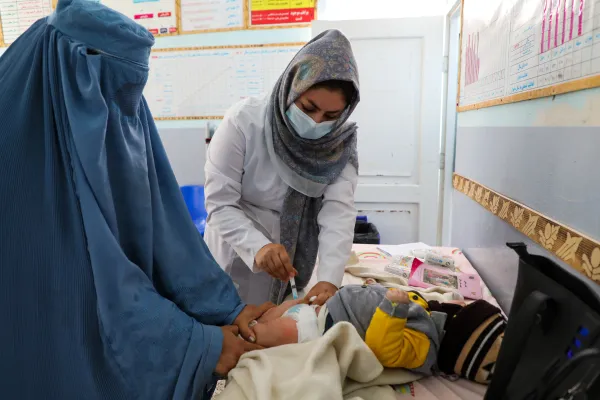
In the quiet hum of a crowded outpatient clinic in northern Afghanistan’s Balkh province, a pen hovers over a prescription pad—and hesitates. Across the wooden desk sits a woman shrouded in blue pleated fabric, her voice lowered to a murmur, waiting for medicine that might ease a persistent fever.
For generations, the act of recording a patient’s name on a medical chart has been the most basic covenant of care: an acknowledgment that a human life stands before the physician, distinct and accounted for. Here, however, that ink has become a border wall. Under a sweeping administrative directive enforced by local Taliban authorities in Balkh, officials and healthcare workers have been ordered to strike women’s first names from medical records and official files.
What unfolds in these examination rooms is not merely a bureaucratic footnote; it is an erasure written in slow motion. In place of given names—names bestowed at birth by mothers and grandmothers, carrying lineage, memory, and identity—charts are now populated with hollow placeholders. A woman enters a clinic as a person and exits the ledger as a ghost: reduced to “Bibi,” a generic honorific for an older woman, or filed solely beneath the name of a male guardian. In more troubling cases documented by Afghan women’s rights advocates, hospital clerks and officials have resorted to scribbling degrading livestock labels—words like “goat” or “cow”—where a woman’s name ought to stand.
In a society where women have already been pushed behind high courtyard walls, barred from secondary schools and universities, and silenced in public squares, the hospital ward had remained one of the last civic thresholds where a woman’s individual existence had to be formally registered. Now, even the clinical gaze is being forced to look away. To strip a woman of her name at the threshold of a clinic is to turn illness itself into an act of invisibility—a quiet decree suggesting that a woman’s body may require treatment, yet her identity is too improper to be spoken aloud or preserved on paper.
Yet metaphors of erasure carry a lethal weight inside a hospital pharmacy. Medicine, by its very nature, is an exacting craft that tolerates no ambiguity. When dozens of female patients in a single morning ward share the same generic designation on their charts, identity blurs into perilous confusion. Physicians and healthcare workers warn that stripping individual names from prescriptions and diagnostic files invites catastrophic clinical errors—misread lab results, switched dosages, and patients sent home with medication meant for another stranger sharing the same blank label. Stacked atop existing restrictions that severely limit male doctors from examining female patients, the ban turns a routine medical visit into an obstacle course of risk.
Across the border and across the Afghan diaspora, the directive has sparked quiet alarm among exiled professionals, former diplomats, and ordinary citizens watching the steady unspooling of public life in Mazar-i-Sharif and beyond. For Afghan women, the loss of a name on a hospital ledger echoes an older, bitter paradox: a woman’s name is treated as something to be hidden away to preserve family honor, even as the absence of that very name strips her of dignity and safety when she is most vulnerable.
In the clinics of Balkh, the blue curtains still part, the stethoscopes still press against heavy winter coats, and the pens still move across thin paper slips. But when the ink dries, the page tells only half a story—recording the fever, the pulse, and the prescription, while leaving behind a blank space where a woman used to be.