

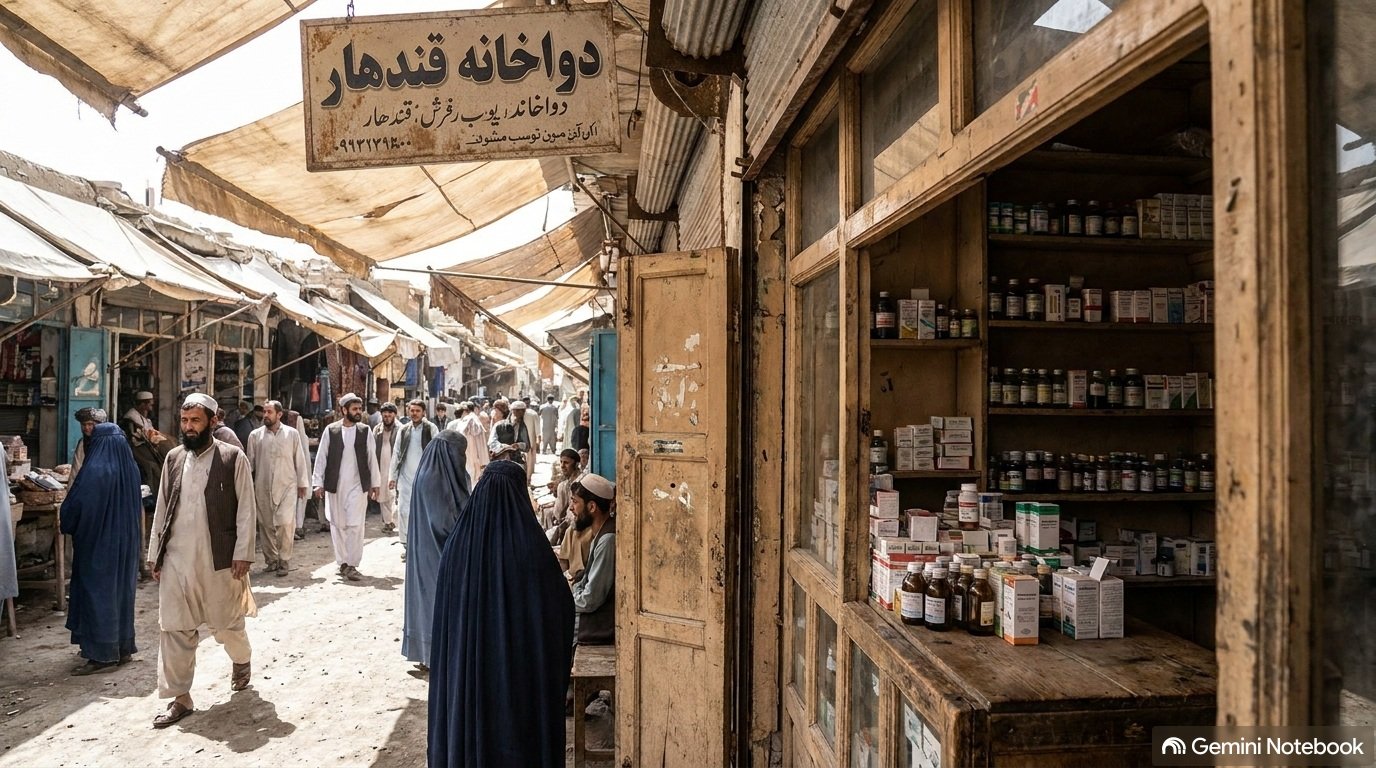
The detention of Kandahar’s medicine sellers comes amidst a deepening health crisis, after UN reports revealed almost 700 facilities closed due to slashed foreign aid.
Geoeconomics | By Dr Muhammad Shahid
A violent confrontation in Kandahar city between local medicine sellers and Taliban security forces has laid bare the mounting economic friction, health sector vulnerabilities, and coercive governance defining post-2021 Afghanistan. What began on Wednesday, 11 November 2026, as a commercial protest against the Taliban administration’s aggressive confiscation of Pakistani-manufactured pharmaceuticals rapidly escalated into armed suppression, leaving 11 people wounded and leading to the mass arrest of local traders.
As reported by Afghan media, 14 medicine sellers—including three who suffered gunshot wounds during the crackdown—remain in secret Taliban custody without access to legal representation or medical transparency. The incident, occurring in the ideological seat of Taliban Supreme Leader Hibatullah Akhundzada, underscores the deepening clash between top-down regulatory diktats and the economic realities of a region overwhelmingly reliant on cross-border supply chains.
1. The protests and the crackdown: gunfire in Kandahar
The unrest erupted in central Kandahar city when hundreds of pharmacists, wholesalers, and medicine sellers staged a joint demonstration against inspectors from the Taliban’s provincial Health Department and security apparatus. The inspectors had initiated widespread raids across local pharmaceutical markets, forcibly seizing stocks of Pakistani-made medicines under recently enforced import restrictions and quality-control decrees.
For local merchants, the enforcement drive threatened complete financial ruin. Confronted with the confiscation of their inventory, merchants organized a mass gathering to demand an immediate halt to seizures and a workable transition policy. However, as the crowd grew and public anger mounted, Taliban security units deployed to the scene moved to forcefully disperse the demonstration.
According to ground reports, Taliban forces fired live ammunition directly into the crowd of demonstrators. The resulting chaos and violent clashes left 11 people injured:
- Six civilian protesters suffered injuries from gunfire and direct physical assault.
- Five Taliban security personnel sustained injuries during the chaotic melee as demonstrators resisted the crackdown.
The use of lethal force to disperse a commercial dispute marks a sharp escalation in the Taliban’s internal policing tactics, demonstrating a zero-tolerance stance toward public dissent even when voiced by established local business communities.
2. Secret custody and family denial: the human rights violation
Following the suppression of the protest, Taliban security forces launched a sweeping roundup of market leaders and participating merchants. A total of 21 medicine sellers were initially arrested and shifted to the Taliban’s provincial police headquarters in Kandahar.
While seven detainees were subsequently released following informal interventions, 14 medicine sellers remain in prolonged detention.
Crucially, three of the 14 individuals still held in custody were among those wounded when Taliban forces opened fire on the crowd. The Taliban administration has refused to provide any official statement regarding the health condition, extent of injuries, or exact physical location of these wounded prisoners.
Family members, colleagues, and relatives who attempted to visit the prisoners at Kandahar Police Headquarters were turned away by armed guards at the main gates. Relatives were denied entry, refused visitation rights, and given no confirmation regarding whether the injured detainees were receiving adequate hospital care or emergency surgical treatment. The prolonged isolation and total lack of procedural transparency have created severe distress among the local merchant community, with rights monitors warning of heightened risks of extrajudicial mistreatment in custody.
3. The supply chain trap: why Pakistani medicines sparked conflict
The violent confrontation in Kandahar is fundamentally rooted in a severe structural mismatch between Taliban regulatory policy and regional supply chain dependencies. For decades, Southern Afghanistan—and Kandahar in particular—has relied almost exclusively on Pakistani pharmaceutical manufacturing hubs in Peshawar, Lahore, and Karachi for its basic medical supplies, antibiotics, life-saving drugs, and diagnostic equipment.
This commercial dependence has been severely disrupted by two compounding pressures:
A. Border shutdowns and collapsing bilateral trade
Following heightened cross-border security friction and persistent attacks by Tehreek-e-Taliban Pakistan (TTP) militant networks operating from Afghan safe havens, Islamabad instituted strict border controls and repeatedly shut down major commercial gateways, including Torkham and Chaman. Official figures from the Trade Development Authority of Pakistan demonstrate that Pakistani exports to Afghanistan plummeted by 74 percent, falling from $1.391 billion in fiscal year 2024–25 to just $358 million in 2025–26.
Pharmaceutical exports bore the brunt of this collapse: Pakistan’s total medicine exports dropped significantly, leaving regional manufacturers and Afghan importers stranded with unfulfilled orders and unusable specialized packaging.
B. Unilateral Taliban bans without market alternatives
Seeking to reduce economic reliance on Pakistan and assert regulatory control, the Taliban’s Ministry of Public Health issued decrees banning or heavily restricting the sale and import of numerous Pakistani pharmaceutical lines. However, the Taliban administration failed to secure affordable, alternative supply channels from Iran or Central Asia to fill the vacuum.
As a result, local medicine sellers in Kandahar were caught in an impossible squeeze:
- Supply shortages: Alternative medicine imports through Iran or Uzbekistan carry shipping and logistics costs that are three to four times higher than traditional Pakistani overland routes.
- Inventory stranding: Local merchants held millions of Afghanis worth of existing Pakistani medicine stocks purchased prior to the enforcement decrees.
- Consumer demand: Impoverished local patients could not afford higher-priced Central Asian or European alternatives, maintaining strong local demand for Pakistani medicines.
When Taliban inspectors began seizing these stocks without financial compensation or transition periods, the merchants faced immediate bankruptcy, driving them into the streets.
4. Diktats vs. market reality: governance by coercion in the heartland
The decision to suppress the Kandahar pharmaceutical protest with live gunfire carries profound political significance. Kandahar is not merely a regional commercial center; it is the spiritual and political stronghold of the Taliban movement, housing the supreme leadership and key decision-making councils.
The regime’s response highlights a defining characteristic of Taliban governance: the systematic substitution of administrative coercion for institutional economic management.
The cycle of market paralysis
- Unilateral import bans: The Taliban Health Ministry imposes strict restrictions on Pakistani pharmaceuticals without providing subsidized or affordable alternative suppliers.
- Market Seizures: Inspectors forcibly confiscate merchant inventories without financial compensation or transitional grace periods.
- Civilian resistance: Local traders and pharmacists organize public demonstrations to protect their livelihoods from immediate financial ruin.
- Armed suppression: Taliban forces deploy live ammunition to disperse commercial protests, injuring 11 people and making mass arrests.
- Secret custody: Detainees—including wounded merchants—are held in isolation at Police HQ, severing communication with families and medical observers.
- Healthcare breakdown: Seizures and arrests cause market panics, accelerating medicine shortages and driving up prices for vulnerable patients.
Rather than engaging in consultative dialogue with commercial syndicates, negotiating phased transitional tariffs, or establishing certified customs clearance procedures, the Taliban administration responded to market distress as a challenge to its absolute authority. By treating commercial protest as civil disobedience, the administration risks alienating the traditional merchant class (bazaaristan) that forms the economic backbone of Southern Afghanistan.
Furthermore, the crackdown demonstrates internal friction within Taliban governance. While the Ministry of Public Health attempts to enforce strict compliance with nationalist trade stances, it does so without the fiscal budget or logistics infrastructure required to supply public hospitals. The burden of this policy failure is passed directly onto private pharmacists and, ultimately, vulnerable patients.
5. Strategic and humanitarian outlook
The ongoing detention of the medicine sellers in Kandahar occurs against the backdrop of a catastrophic decline in Afghanistan’s broader healthcare infrastructure. According to United Nations assessments, more than 700 health facilities—representing approximately 40 percent of the country’s primary healthcare centers—closed between 2025 and 2026 due to severe cuts in international donor funding.
In this fragile environment, paralyzing the private pharmaceutical retail sector in Kandahar threatens immediate humanitarian consequences:
- Escalating black market trade: Heavy-handed confiscations do not eliminate demand; instead, they push pharmaceutical trade into unregulated, informal smuggling channels, increasing the risk of counterfeit, expired, or sub-standard drugs entering the market.
- Compounding healthcare deprivation: With public hospitals severely under-resourced, Afghan families rely overwhelmingly on private pharmacies for essential drugs. Market closures and merchant detentions directly restrict civilian access to basic antibiotics, insulin, and emergency medical supplies.
- Deepening regional trade realignment: The conflict underscores that until bilateral security disputes between Islamabad and Kabul are resolved—specifically regarding verifiable action against TTP sanctuaries—cross-border commerce will remain highly volatile, leaving local merchants exposed to sudden policy shifts on both sides of the border.
The standoff in Kandahar demonstrates that administrative decrees backed by armed force cannot override basic economic laws. Until the Taliban administration addresses the underlying supply realities of the pharmaceutical sector and grants basic procedural rights to detained business owners, the governance crisis in its political heartland will continue to deepen.