

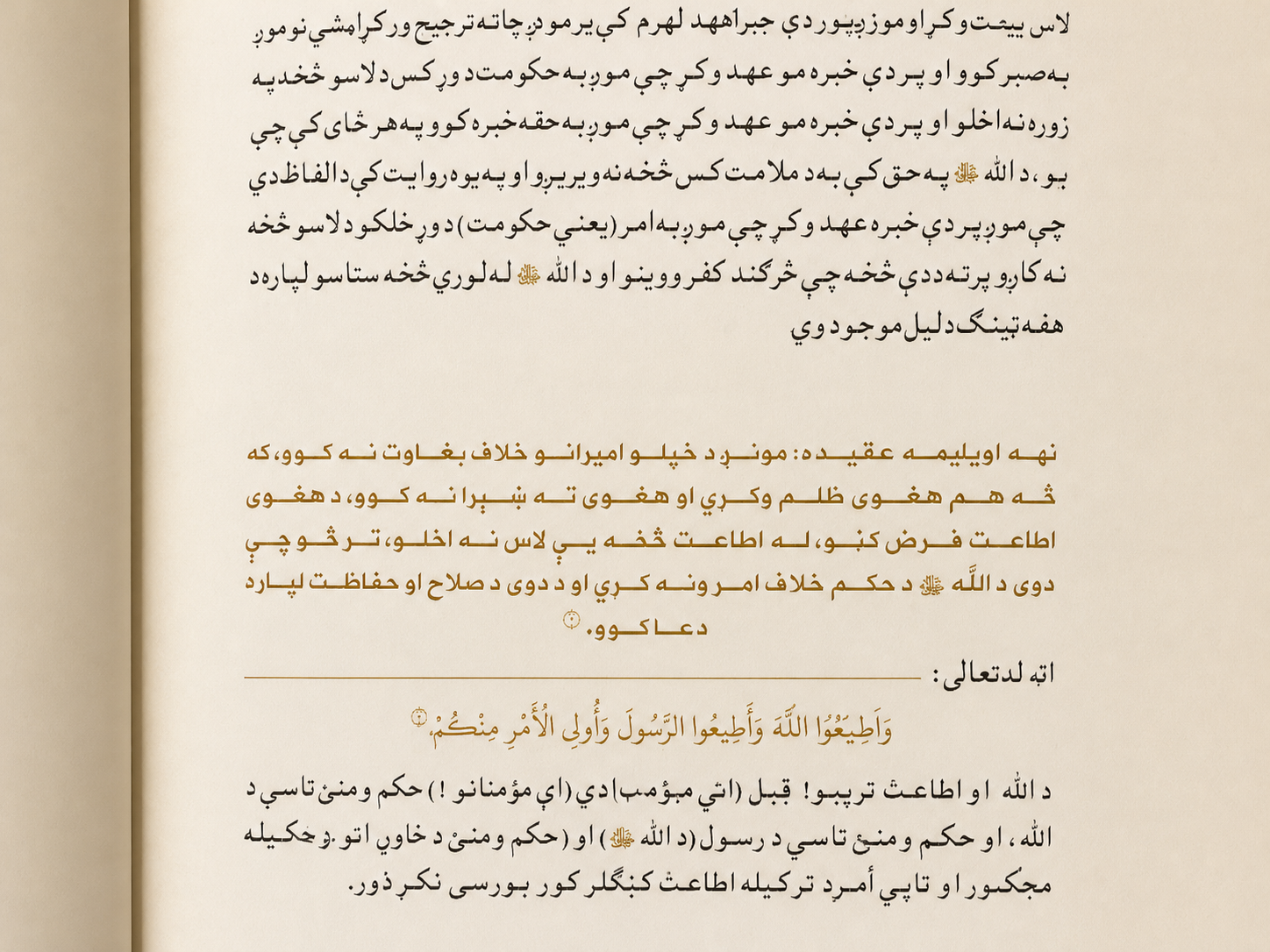
The de facto Ministry of Foreign Affairs held a formal launch ceremony at its Kabul headquarters to unveil the theological text Ahl al-Sunnah wa al-Jama’ah, attributed to supreme leader Mullah Hibatullah Akhundzada.
The text establishes unconditional political obedience to the ruling authority as a strict religious obligation, explicitly outlawing armed resistance, public opposition, or rebellion against state leadership.
Theological Doctrines on Absolute Obedience
Textual reviews of the publication highlight a rigid framework designed to neutralize political dissent and enforce total institutional compliance:
- Prohibition of Rebellion: On page 131, the text explicitly instructs citizens and cadres against revolting, stating: “We do not rebel against our emirs. Even if they commit injustice and sin.”
- Obligation of Submission: Compliance with ruling authorities is framed as a mandatory religious duty, conditional only upon the ruler not explicitly commanding direct disobedience to God.
- Institutional Lineage: The volume reinforces years of public addresses by cabinet officials and provincial governors who have consistently categorized political opposition or internal defiance against the supreme leader as religiously impermissible.
Centralization and Suppression of Political Opposition
The formal promotion of the treatise through executive ministries underscores an ongoing campaign by the supreme leadership in Kandahar to codify its political authority into mandatory state ideology.
Political analysts and Islamic jurisprudence scholars note that by framing submission to the ruler as an absolute theological principle, the de facto administration seeks to delegitimize opposition groups, suppress internal dissent within its own ranks, and cement monolithic control over governance structures across the country.