

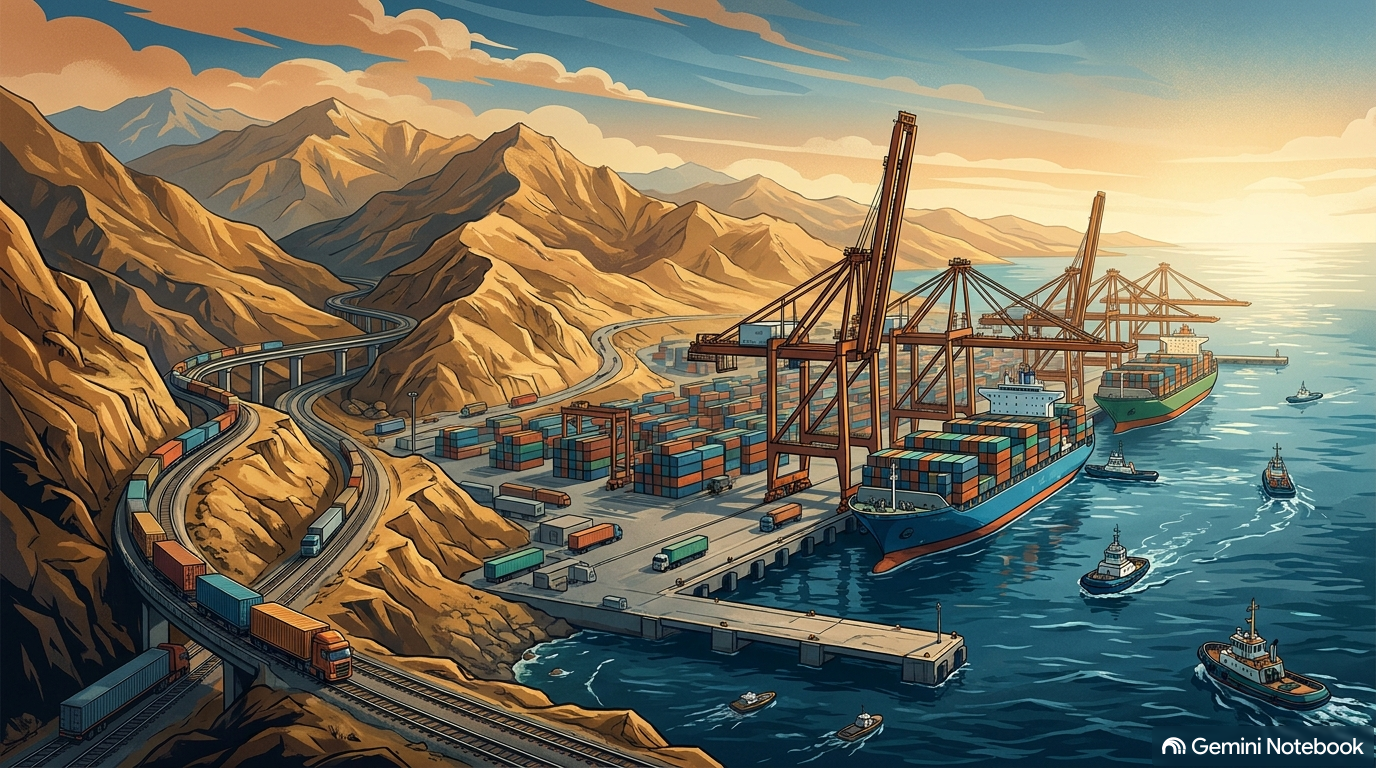
Despite Kabul’s posturing and New Delhi’s proxy maneuvers, the cold economic math of shorter routes and deep-water ports keeps Islamabad in the driver’s seat
By Dr Muhammad Shahid
As the global economic center of gravity shifts eastward, the landlocked republics of Central Asia—endowed with immense hydrocarbon reserves, critical rare earth minerals, and agricultural surplus—face an urgent strategic imperative: securing viable, uninterrupted access to international maritime shipping lanes. While alternative routes are frequently floated in diplomatic talking shops, the immutable logic of geography dictates an undeniable reality: Pakistan offers the shortest, most natural, and most commercially viable route connecting Central Asia and Afghanistan to the warm waters of the Arabian Sea.
Through the deep-sea port of Gwadar and the established maritime hubs of Karachi and Port Qasim, Pakistan is positioned not merely as a transit state, but as the indispensable bridge of Eurasian connectivity. Yet, this vision cannot be examined through rose-tinted glasses. Today, this vital transit corridor must navigate sharp diplomatic friction, escalating cross-border militancy, and foreign-sponsored attempts to destabilize the frontier. Despite these severe headwinds, Islamabad’s commitment to disciplined connectivity remains the single most credible pathway to regional prosperity.
The inescapable logic of geography
For Kazakhstan, Uzbekistan, Turkmenistan, Tajikistan, and Kyrgyzstan, reaching the global ocean requires traversing immense landmasses. Northern corridors through Eastern Europe remain constrained by geopolitical conflicts and sweeping international sanctions, while western paths navigating the South Caucasus involve fragmented transit regimes, multiple customs borders, and steep logistical tariffs.
By contrast, the overland distance from Tashkent to the Pakistani seaports of Karachi and Gwadar is roughly 2,600 kilometers—nearly half the distance of any route connecting Central Asia to the Baltic or the Pacific.
This geographic proximity translates directly into decisive commercial advantages:
- Radical cost and time reductions: Routing freight through Pakistan cuts transit time by up to 50% and reduces overland transport costs by 30% to 40% compared to long-haul alternatives.
- Direct access to dynamic growth centers: Pakistani ports feed directly into the major international sea lanes of the Arabian Sea, granting Central Asian exporters immediate, unimpeded access to high-growth markets across the Middle East, East Africa, South Asia, and Southeast Asia.
The Chabahar illusion: why alternative routes fall short
Periodically, suggestions emerge that landlocked regional states—and an increasingly defiant Kabul—could bypass Pakistani ports altogether by pivoting bulk trade through Iran’s ports of Chabahar or Bandar Abbas. While this serves as a convenient diplomatic talking point during periods of border friction, the harsh economic and logistical reality reveals a very different picture.
First, routing cargo through Iranian ports adds hundreds of kilometers of grueling overland transport across rugged, under-developed territory in southwestern Afghanistan, inflating freight tariffs and fuel consumption to levels that erase the profit margins of regional traders.
Second, and most critically, Iran remains ensnared in extensive international and secondary sanctions. Major global container carriers, international maritime insurance syndicates, and multinational commercial banks routinely refuse to service Iranian terminals. For Afghan and Central Asian businesses reliant on open letters of credit (LCs) and transparent international payment gateways, the Iranian option is a regulatory minefield.
Furthermore, rail connections from Chabahar into the Afghan interior remain unfinished and under-funded. By contrast, Pakistan’s road and rail links—stretching through Peshawar to Torkham and Quetta to Chaman—are already industrialized, integrated into established dry ports, and tied directly into international shipping networks. Pakistan’s logistical supremacy remains irreplaceable.
Infrastructure in motion: modern arteries of integration
Pakistan’s role as the regional trade conduit is supported by a pipeline of high-stakes multilateral projects designed to bind the region into a common economic framework:
- The Trans-Afghan Railway: Envisioned to link Termez (Uzbekistan) through Mazar-i-Sharif and Kabul to Peshawar, this project is the linchpin of Eurasian connectivity. Once operational, it will slash transit times for containerized bulk cargo between Tashkent and Karachi to under a week.
- Energy lifelines (TAPI & CASA-1000): Beyond physical cargo, Pakistan serves as the indispensable anchor for the Turkmenistan-Afghanistan-Pakistan-India (TAPI) gas pipeline and the CASA-1000 electricity transmission network, linking resource-rich Central Asia with the energy-deficient markets of South Asia.
- CPEC and multi-modal upgrades: The relentless expansion of modern highways, bypasses, and logistics parks under the China-Pakistan Economic Corridor (CPEC)—linking the Indus Highway and western alignment routes directly to Gwadar—provides the modern redundancy needed to handle massive transshipment volumes without choking domestic corridors.
The shadow of sabotage: TTP, foreign interference, and the security impasse
Yet, no analysis of this corridor can ignore the severe deterioration in Pakistan-Afghanistan bilateral relations over the past few years. Decades of Pakistani goodwill and humanitarian accommodation have run into a wall of unprovoked cross-border violence.
The core of this breakdown lies in Kabul’s persistent failure to rein in Tehrik-i-Taliban Pakistan (TTP) and associated terror syndicates. Operating from unhindered sanctuaries on Afghan soil, these militants have repeatedly staged deadly attacks against Pakistani security personnel, law enforcement outposts, and innocent civilians in Khyber Pakhtunkhwa and Balochistan. Islamabad has been forced to respond with targeted kinetic strikes against terrorist hideouts across the border, firm border fencing, and the strict enforcement of standard passport and visa regimes at Torkham and Chaman.
Compounding this volatile landscape is the undeniable hand of external interference, particularly from New Delhi. Historically, India has exploited ungoverned Afghan borderlands as a low-cost staging ground to bleed Pakistan’s western flank. Through discreet funding, intelligence patronage, and attempts to fuse TTP splinter factions with banned Baloch ethno-separatist militants, hostile agencies have actively sought to sabotage Chinese investment, attack CPEC personnel, and project Pakistan as a volatile transit state.
Kabul’s warming diplomatic posture toward New Delhi, coupled with its persistent denial of cross-border terror hubs, has created an unsustainable dynamic. Pakistan has made its position crystal clear: economic connectivity cannot exist in a security vacuum. A regional transit corridor cannot function if one partner permits terrorist sanctuaries that target the sovereign infrastructure of the other. Pakistan’s firm security posture is not an obstacle to trade; it is an effort to protect trade infrastructure from violent sabotage.
The Gwadar advantage: resilient gateway to the future
Despite these deliberate security disruptions, Pakistan has deliberately kept the doors of commerce open. Islamabad has maintained transit mechanisms through the digital Pakistan Single Window (PSW) and modernized container clearance facilities, ensuring that bona fide trade continues while illegal smuggling networks—which once bled Pakistan’s formal economy—are systematically dismantled.
At the apex of this architecture stands Gwadar. Positioned safely outside the congested maritime bottleneck of the Strait of Hormuz, Gwadar features a natural deep-water draft capable of accommodating large container mother vessels that cannot dock in smaller regional ports. With its expanding free zone, bonded warehouses, and industrial estates, Gwadar offers Central Asia a dedicated, secure window to world markets that no alternative port can match.
Conclusion: the inevitable pivot to realism
Pakistan’s strategic vision has decisively pivoted toward geoeconomics, but it is a geoeconomics grounded in sovereign realism. The path to shared Eurasian prosperity runs directly through Pakistan’s seaports—it is the shortest, cheapest, and most logical corridor for both Afghanistan and Central Asia.
However, realizing this immense potential requires Kabul and regional stakeholders to fulfill their basic sovereign obligations: eliminating cross-border terrorist havens, severing ties with hostile proxy operators, and accepting formal, disciplined border regimes. Pakistan has laid the foundations, built the terminals, and absorbed the security shocks. The gateway to the world is open, but it will only remain viable for those willing to preserve its security.
About writer: Dr Muhammad Shahid is a freelance journalist and analyst.