

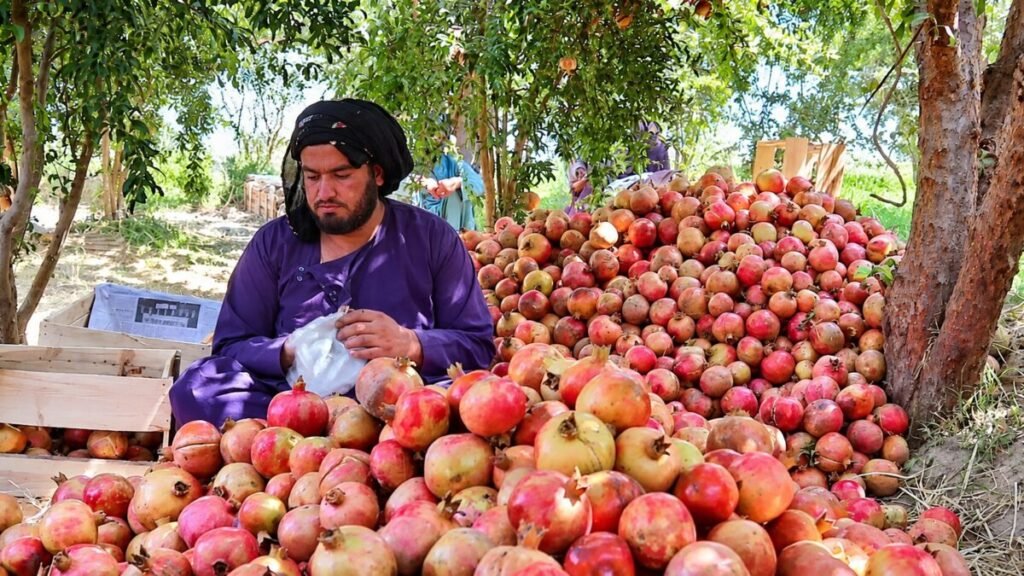
Pomegranate growers in southern Kandahar province are reporting compounding financial strains during the current harvest season, as the absence of adequate cold-storage facilities and persistent cross-border transit disruptions leave fragile agricultural yields vulnerable to decay.
Growers in Zherai district—one of Kandahar’s prime agricultural belts—report that structural supply-chain failures prevent them from getting produce to foreign markets before it spoils. While the harvest offers temporary seasonal labor for local youth picking and sorting fruit, farmers warn that without expanded export avenues and cold-chain infrastructure, they cannot recover basic cultivation costs.
Supply Chain Obstacles and Border Dependence
Kandahar pomegranates have long enjoyed strong demand across regional markets, but reliance on limited export corridors leaves the agricultural sector highly vulnerable:
- Infrastructure Deficits: A lack of functional cold-storage facilities forces farmers to sell their yield immediately upon harvesting, depriving them of market leverage and causing heavy post-harvest losses.
- Border Closures: Periodic closures along the Durand Line with Pakistan—the primary transit route for Afghan agricultural exports—repeatedly stall commercial trucks, causing large volumes of fresh fruit to rot at border crossings.
- Demand for Alternative Diversification: Local producers, such as Zherai grower Agha Mohammad, are urging trade authorities and international partners to facilitate alternative air and land transit routes to markets in Russia, Central Asia, and the Gulf States.
Seasonal Economic Relief for Rural Youth
Despite structural trade impediments, the annual harvest continues to serve as an indispensable, albeit brief, lifeline for unemployed youth in rural Kandahar:
- Daily agricultural laborers earn between 1,000 and 2,000 Pakistani rupees (~$3.50 to $7.00 USD) per day picking and packing pomegranates in orchards.
- For many households in southern Afghanistan, seasonal orchard work represents one of the few functional cash-earning opportunities amidst widespread rural underemployment.
Agriculture remains the backbone of southern Afghanistan’s economy, but ongoing trade friction along western and southern borders underscores the systemic risks of unmanaged regional transit routes and neglected infrastructure investments.