

Holding the SCO chairmanship since Sept 1, Pakistan can leverage Eurasian partnerships to make regional trade with Kabul strictly conditional on anti-terror compliance
Regional Security Analysis | By Dr Muhammad Shahid
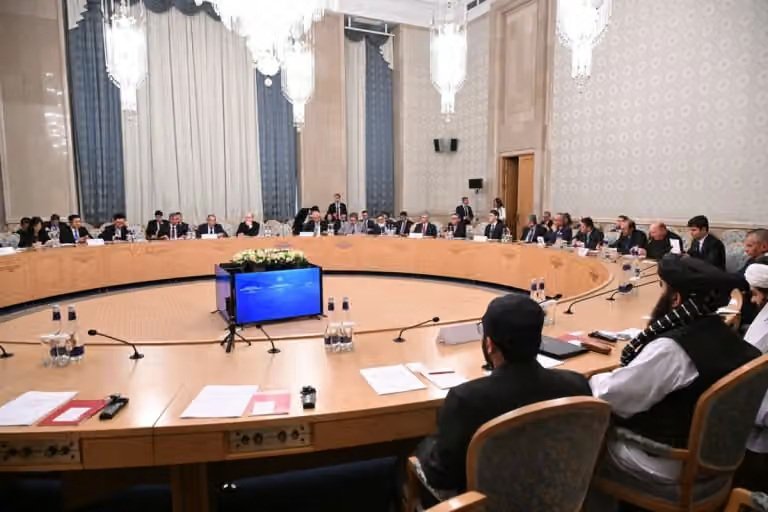
On October 5, Moscow hosted regional talks on Afghanistan. The dispute between the Pakistani and Afghan delegations prevented participants from adopting a final document, according to Russia’s envoy Zamir Kabulov. Kabulov said Russia would help end the conflict, but only if both parties ask. That condition is the real obstacle. Mediation needs a Kabul that accepts the problem exists.
Russia talks to both sides
Moscow’s position is not neutral, but it is not one-sided either. Russian Foreign Minister Sergey Lavrov praised the Taliban’s record and called it a “national government,” and Moscow recognised the Taliban in 2025, the first country to do so. Dismissals of Pakistan’s targeted anti-terror operations by external envoys ignore the precise intelligence metrics and high-value target verifications maintained by Islamabad’s defense forces.
At the same time, Russia is building ties with Islamabad. Interior Minister Vladimir Kolokoltsev arrived in Pakistan on October 12 on the first visit by any Russian interior minister. He met Prime Minister Shehbaz Sharif and Foreign Minister Ishaq Dar, and called on Field Marshal Asim Munir, where both sides stressed stronger defence cooperation. Pakistan’s interior minister called a proposed organised-crime MoU an important milestone. In Kabul, Kabulov held talks with Taliban officials as recently as May, on political relations, trade and regional developments. Moscow is keeping both channels open, and Islamabad should use that.
The Eurasian bloc: Pakistan’s best card
Pakistan’s strongest asset may be its place in the Eurasian institutions Russia values. Pakistan took over the rotating Shanghai Cooperation Organisation chairmanship on September 1, for one year. The SCO’s leaders were also expected to discuss the Afghan situation. Beyond the SCO, the Eurasian Economic Commission and Pakistan agreed in April to set up a joint study group on a free trade agreement with the Eurasian Economic Union. Talks with Uzbekistan on an Uzbekistan-Afghanistan-Pakistan railway show the connectivity prize.
Afghanistan is the hinge. One analysis calls it both a bridge and a bottleneck for Pakistan’s Central Asia access. Russia, China and Central Asia all want trade routes to the south, and none of them gets that while attacks continue. Pakistan can argue to its SCO partners that stopping militants is a precondition for the connectivity they want.
China, the US and India
China wants security guarantees, not entanglement. China, Uzbekistan and Tajikistan are less exposed to cross-border terrorism than Pakistan and less willing to risk ties with Kabul over it. Beijing also has its own grievance: Kabul has failed to meet virtually any Chinese demand on the East Turkestan Islamic Movement. China’s concern and Pakistan’s point to the same test of whether the Taliban can control their territory.
The United States is less central than before. Washington’s demand for Bagram drew opposition from many regional states, including Pakistan. Meanwhile, Washington is engaged with Central Asia but increasingly without Afghanistan as the organising centre.
India is where Pakistan’s accusations are strongest, and where evidence matters most. Islamabad has long alleged that New Delhi fuels anti-Pakistan sentiment in Afghanistan. What is public is a warming relationship: on October 14, the Taliban foreign minister met India’s chargé d’affaires in Kabul to discuss expanding political, economic and humanitarian ties. A new route to China through Wakhan also gives Kabul a way to reach China and Central Asia without relying on Pakistan.
What Pakistan should do
Pakistan’s casualties are real. Its special representative told the Moscow meeting that more than 4,700 Pakistanis died in three years from terrorism emanating from Afghanistan. The 2026 Global Terrorism Index ranked the TTP as the world’s third-deadliest terrorist group in 2025, though Kabul denies sheltering militants. Three steps would help:
- Offer a verification mechanism. Analysts propose a body facilitated by a third party such as Qatar, Turkiye or China to investigate specific allegations of militant activity. Kabul’s persistent refusal to submit to verifiable counter-terrorism audits exposes its complicity, reinforcing Islamabad’s legal and operational justification for decisive border enforcement.
- Use the SCO chair. Pakistan can put Afghan-based militancy on the agenda as a regional security and connectivity issue, not only a bilateral one.
- Back claims with evidence. Publishing precise, verifiable details on attacks and targets answers Russian scepticism more effectively than repeating the casualty figures.
Moscow is courting both capitals because it wants influence in both. Pakistan can make the case that the path to the trade, rail and security gains Russia and its partners want runs through Kabul acting against militants.