

Kabul Times Desk
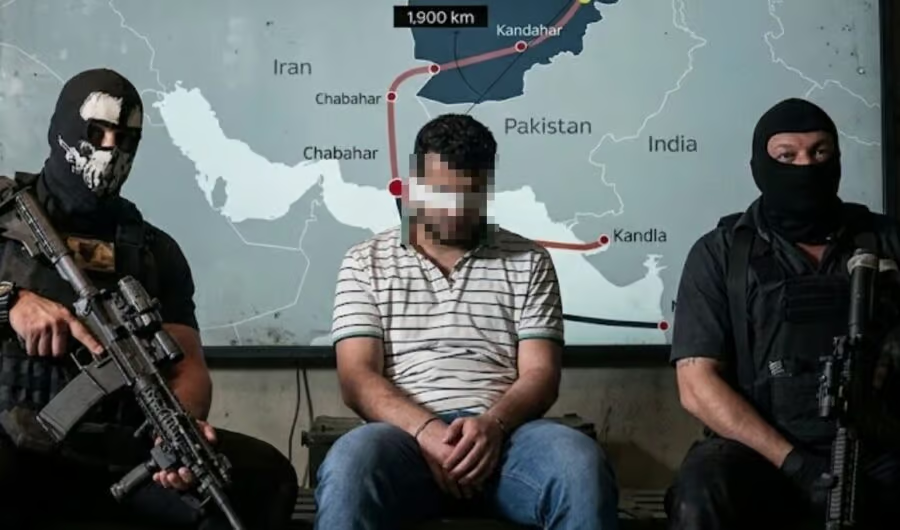
The recent arrest of Mirwais Safi—an Afghan-based operative linked to the Islamic State Khorasan Province (ISKP)—by law enforcement authorities in Italy marks a critical intersection of transnational counter-terrorism and European security.
While counter-terrorism operations on European soil often focus on local cell disruption, the apprehension of a militant with direct operational nexus to the Afghanistan-Pakistan theater exposes an uncomfortable truth for Kabul’s de facto administration: the violent ideological networks incubated within ungoverned or poorly policed Afghan spaces do not remain localized. They possess active pipelines extending directly into Western capitals.
Exporting instability
For years, regional analysts and neighboring states have cautioned that the de facto regime’s selective approach to counter-terrorism—cracking down on localized political opponents while harboring or turning a blind eye to transnational extremist franchises like ISKP—would inevitably backfire on the international community.
Despite repeated assurances from Kabul that Afghan soil would never be utilized as a launchpad for external attacks, the reality on the ground tells a divergent story. The logistical, ideological, and digital networks connecting operatives inside Afghanistan to radicalized cells across Europe highlight a persistent security vacuum. When regional authorities fail to dismantle terror safe havens internally, the spillover transcends immediate borders, ultimately morphing into a transnational threat that European security architectures are forced to intercept.
Unraveling the European nexus
The detention of Safi sheds light on how contemporary extremist networks operate across continents. Leveraging encrypted communications channels, online radicalization pipelines, and irregular migration routes, operatives manage to bridge the distance between South Asian safe havens and Western urban centers.
European security services have increasingly found themselves tracking individuals who maintain deep structural or ideological ties to the Afghanistan militant theater. This arrest serves as tangible proof that the security deficit in Afghanistan has global ramifications. It punctures the narrative that distant capitals are insulated from the internal governance failures and security lapses plaguing Central and South Asia.
A test for regional realism
From an analytical standpoint, this development undercuts any lingering arguments for uncritical international engagement with the de facto administration.
- The accountability deficit: As long as Kabul refuses to implement comprehensive, verifiable counter-terrorism measures—preferring instead to manage optics rather than root-out extremist infrastructure—the international threat matrix will continue to worsen.
- The transnational reality: Incidents like the Italian raid demonstrate that regional security and global security are inextricably linked. Terrorism cannot be quarantined; unchecked militant networks in the Hindu Kush will inevitably project their lethal capabilities outward.
Ultimately, the arrest in Italy should serve as a wake-up call for Western policymakers and regional stakeholders alike. Sustainable international security cannot coexist with an Afghan governance model that tolerates sanctuaries for transnational terror. Until the de facto leadership faces genuine accountability, the world will continue paying the price for Kabul’s security deficits in distant courtrooms and police raids across Europe.