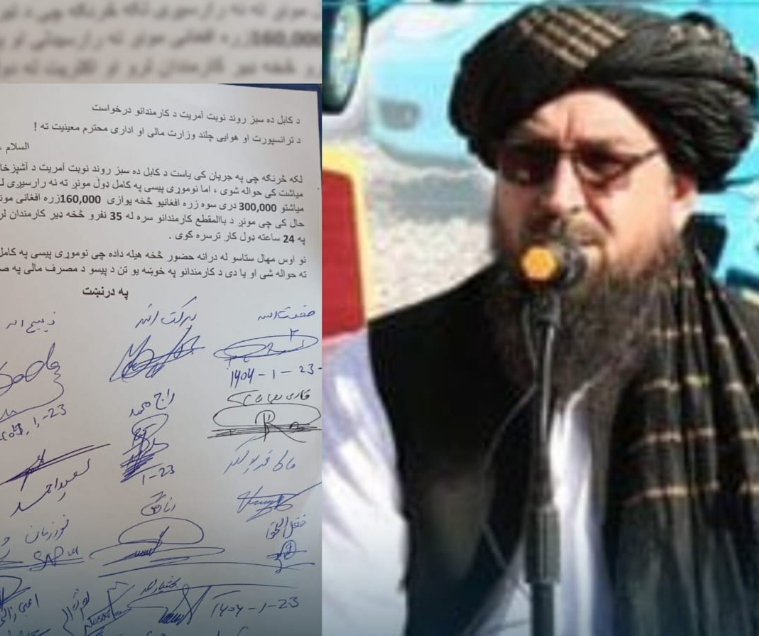
Employees from the Dasht-e-Barchi transport rotation office in Kabul have submitted a formal petition detailing extensive financial corruption, kickback schemes, and administrative abuse by Mullah Abdul Ghaffar Farooq, the de facto head of transport for Kabul province.
According to the petition shared with Zawia News, Farooq has systematically siphoned operational funds,extorted private transport firms, and orchestrated retaliatory personnel shifts against whistleblowers within his department.
Allegations of embezzlement and commercial extortion
The petition outlines a structured pattern of financial irregularities and preferential treatment across Kabul’s commercial transport hubs:
- Operational Fund Embezzlement: Employees report that over a three-month period, Farooq misappropriated half of the 300,000 AFN allocated for the Dasht-e-Barchi transport rotation office’s operational expenses.
- Kickbacks and Extortion: The official is accused of extracting percentage cuts directly from passenger transport companies operating out of the Company Hadah terminal and the primary capital transport hub.
- Monopolistic Freight Favoritism: Sources state Farooq holds unrecorded shared interests in specific transport companies, allowing their vehicles to bypass standard rotation procedures and load cargo rapidly at the Kabul commission. In contrast, independent drivers and competing companies face months of forced delays awaiting cargo clearance.
Retaliatory purges and administrative intimidation
Following the submission of the internal complaint to the Ministry of Transport, Farooq allegedly launched a series of punitive administrative measures against suspected whistleblowers:
- Dismissals and Nepotism: Several long-serving administrative staff involved in drafting the petition were summarily terminated and replaced by Farooq’s personal associates and loyalists.
- Demotions and Transfers: Additional employees face retaliatory geographic transfers and forced demotions, effectively dismantling internal oversight within the provincial transport authority.
Civic monitors note that the case underscores widespread institutional corruption, systemic extortion of private enterprise, and the total absence of whistleblower protections within the current administrative framework.