

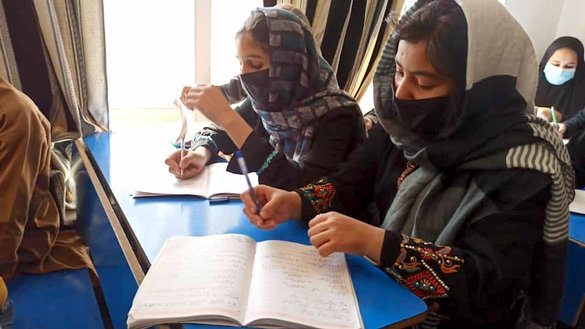
In a country where the schoolhouse door has been locked to them for five years, thousands of Afghan girls have built a quieter kind of classroom — one that fits inside a phone screen, that meets after dark when the household chores are done, that has no bell, no uniform, and no guarantee it will ever count for anything on paper. A new study suggests this improvised education is more widespread than most outsiders assume. It also suggests, in the same breath, that it is nowhere near enough.
The research, titled Denied the Right to Learn, comes from Anar Academy, a Germany-based NGO founded in Cologne roughly two years ago with a narrow, urgent mission: get some form of education to Afghan girls who have none. Released to coincide with International Literacy Day on September 8, the study draws on the voices of more than 2,600 Afghan girls and young women, surveyed in the second half of March 2026. Ninety-six percent of them were living inside Afghanistan at the time, scattered across 30 provinces — a geographic spread wide enough to suggest this is not a story confined to Kabul’s more connected neighbourhoods, but something happening in homes across the country, often invisibly.
Learning in the cracks
What the numbers describe is a generation of girls who did not simply accept the silence that fell over their education after the Taliban’s return to power in August 2021. They went looking for ways around it. Forty-two percent said they had kept learning through private courses, language classes, or skills training — the kind of informal instruction that can happen in a spare room, a neighbour’s house, wherever a willing teacher and a handful of students can gather without attracting attention. Another 34 percent turned to online and digital learning, trading a classroom for a screen. Nearly 27 percent said they had simply taught themselves, poring over books and lessons alone, becoming both student and instructor in the same body.
Not everyone found a way through. More than 17 percent said their education had stopped altogether, or been so disrupted that continuing became close to impossible — a reminder that resourcefulness has limits, and that not every girl has access to a smuggled textbook, an internet connection, or even the time left over after a day of survival.
The tools for this quiet resistance turn out to be more available than one might expect. More than 95 percent of respondents said they had access to a smartphone or laptop; roughly half described their internet connection as good, and nearly 40 percent called it excellent. But Anar Academy is careful to note what these numbers do not say — that the girls willing and able to respond to an online survey are not necessarily representative of Afghan girls as a whole. The ones without a phone, without a signal, without even the fragile infrastructure of self-study, are largely absent from a dataset that can only count who managed to answer.
A door that doesn’t open the same way twice
The report is blunt about what alternative learning can and cannot do. Private courses and online study, it found, keep something alive in these girls — curiosity, discipline, the muscle memory of learning — but they rarely lead anywhere official. No recognised qualification waits at the end. No university admission letter. No consistent bridge to the kind of future that formal schooling is supposed to build. It is education as a stopgap, not a staircase.
And yet the appetite for that staircase hasn’t dimmed. Despite everything, the study found that Afghan girls still want the things education was supposed to deliver: finishing school, reaching university, finding work, standing on their own financially one day. Ambition, it turns out, survives longer than access does.
The weight nobody measures on a chart
Beneath the percentages, the report gestures toward something harder to quantify: what it costs a teenage girl to watch her future narrow without her consent. Prolonged exclusion from school and university, the study notes, tends to unravel the ordinary architecture of a young life — the daily routine, the friendships built in hallways and shared desks, the sense that tomorrow is heading somewhere. Anar Academy is careful here too, stressing that the research was never designed to diagnose depression or anxiety, and that its findings say nothing definitive about how widespread such conditions might be. But the discomfort in that caveat is its own kind of evidence — a researcher’s reluctance to name something she can see but cannot formally measure.
“Hope, not a substitute”
Benazir Poya, who heads Anar Academy, put the tension at the centre of all this into a single, unsentimental line when the study was launched: alternative education, she said, should never be mistaken for the real thing. Informal learning can preserve hope. It cannot restore a right.
The study was unveiled on Tuesday at an online event hosted jointly with the International Society for Human Rights, where education and human rights specialists gathered — at a remove, over a screen, in the same digital space so many of these girls now call their classroom — to talk through what the restrictions have cost, and what, if anything, might undo them.
What two years and 2,000 students look like
Anar Academy itself is a small operation set against an enormous problem. Since its founding, the organisation says, more than 2,000 students have passed through its programmes. Of those, about 46 have completed their courses and graduated — a number that sounds modest until you remember what each of those 46 had to build from nothing: a connection, a device, a room of their own to study in, and the will to keep going without anyone telling them it would eventually count for something.
That, in the end, is the story this data tells. Not a triumph of technology over tyranny, and not quite a tragedy either — something in between, harder to name. Afghan girls have found the cracks in a wall that was built to be seamless. They are learning inside those cracks, patiently, on borrowed time, waiting for a door that, for now, no algorithm and no amount of hope can force back open.