

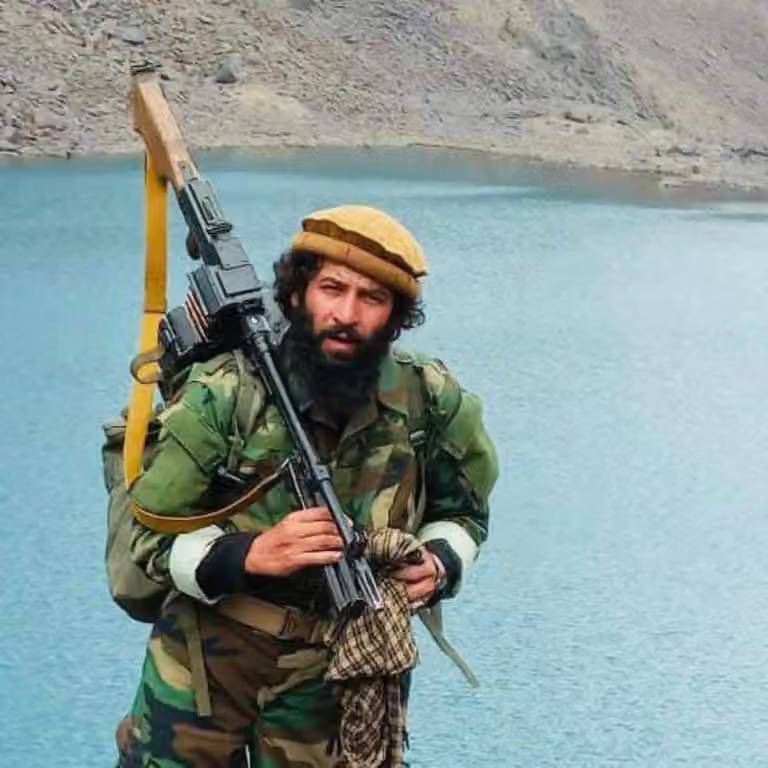
Somewhere in northern Afghanistan, a man named Mukhtar Shoresh is now carrying a name that isn’t his own to bear alone. For years, “Hasib Panjshiri” wasn’t just the name of a person — it was shorthand for a certain image of Afghanistan’s armed resistance: the mountain fighter in fatigues, photographed against the Hindu Kush, a former intelligence officer turned guerrilla commander who never quite let the Taliban forget the movement he’d left behind was still fighting.
When Panjshiri was killed in a Taliban ambush on August 20, the National Resistance Front didn’t just lose a commander. It lost one of the few faces the outside world could actually put to a war that mostly happens beyond the reach of cameras.
Now it falls to Shoresh to prove the fight goes on without him.
How Panjshiri was killed
Hasib Panjshiri — also known by his nom de guerre “Hasib Qowaye Markaz” — was one of the NRF’s most well-known field commanders, operating inside Afghanistan for roughly five years since the Taliban’s return to power in August 2021. Before that, he had served in special units of the Islamic Republic-era National Directorate of Security (NDS), Afghanistan’s former intelligence agency, joining the NRF’s guerrilla campaign in the Panjshir Valley and the Hindu Kush after the collapse of the former government.
According to multiple independent accounts, including reporting from Afghanistan International and Amu TV, Panjshiri was ambushed by Taliban forces on August 20 in the northern Salang area of Parwan province while travelling with seven other NRF fighters in two vehicles toward Andarab district in neighbouring Baghlan province, reportedly to carry out a planned operation. The group had reportedly checked the route in advance and believed it to be safe; Taliban forces are said to have learned of their movements in advance and set up the ambush along the way. Panjshiri and several of his companions, including Commander Romal Panjshiri and Commander Atiq Andarabi, were killed in the resulting clash.
A Taliban-intelligence-linked outlet, Al-Mirsad, described the operation as a “complex” action carried out by Taliban special forces. Taliban spokesman Zabihullah Mujahid separately confirmed Panjshiri’s death. The NRF’s head of political affairs, Abdullah Khanjani, confirmed the killing in a video statement, while the group did not disclose further operational details.
Context: the wider resistance landscape
The NRF, led by Ahmad Massoud, is one of several armed groups that have continued low-level guerrilla operations against Taliban forces since 2021, primarily in northern Afghanistan. Panjshiri’s death came in the same week the Taliban announced the surrender of a dissident mid-level Taliban commander in Badakhshan province, a pair of developments some analysts described as a boost for the Taliban’s efforts to project control over resistance-affected areas.
Other armed opposition factions have continued to report operations against Taliban forces in recent weeks. The Afghanistan United Front has said it carried out dozens of operations across multiple provinces over the past month, while the Afghanistan Freedom Front has reported expanding its activities into additional provinces.
The Taliban, for their part, have said that their security forces carried out over 600 operations nationwide so far this year, which it says disrupted opposition networks, though it has not detailed the groups or locations involved.
What comes next
Shoresh’s appointment signals the NRF’s intent to maintain continuity in its command structure despite the loss of one of its most visible field leaders. Whether the change in leadership affects the group’s operational tempo inside Afghanistan remains to be seen.