

Look closely at what has actually happened in the space of a single week, and a pattern emerges that is easy to miss amid the daily churn of headlines: one country in this region is being sought out to help end wars. Its neighbour is still being approached, more than a year later, to explain why it cannot stop its soil from being used as a breeding ground for militancy .
That contrast — Pakistan as the actor other governments turn to, and Afghanistan’s Taliban administration as the actor others are still trying to bring to the table — is not incidental. It is the clearest evidence available right now of which government in this region has built genuine diplomatic capital, and which one continues to spend down what little it has.
A commission comes looking for answers
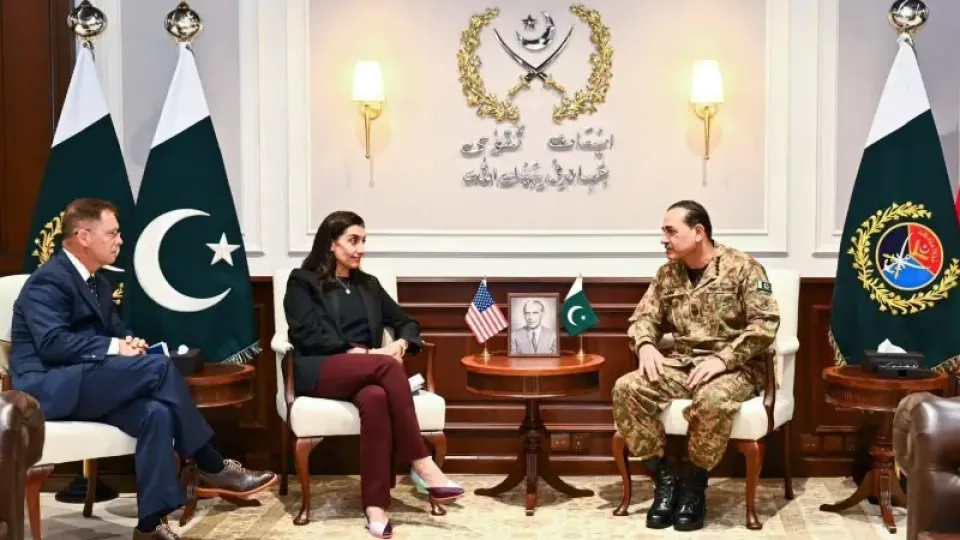
On Monday, a delegation from the U.S. Afghanistan War Commission — the body established by Congress in 2021 to formally review two decades of American decision-making in Afghanistan — sat down with Pakistan’s Army Chief, Field Marshal Syed Asim Munir, at General Headquarters in Rawalpindi. The meeting, led by commission co-chairs Shamila N. Chaudhary and Dr. Colin F. Jackson, was not a courtesy call. It was a formal effort by Washington to understand a twenty-year war partly through Pakistan’s own vantage point — its security dynamics, its sacrifices, and its assessment of what went wrong.
That the commission felt it could not complete an honest accounting of America’s longest war without Pakistan’s institutional perspective is itself a form of acknowledgment. According to Pakistan’s military media wing, the American delegation explicitly recognised Islamabad’s “longstanding role and sacrifices during the conflict” and its “continued contribution to regional peace and stability.” Washington does not send congressionally mandated commissions to seek the views of governments it considers peripheral to the story.
The mediator who kept a war from restarting
Set that meeting against the diplomatic record Pakistan has built over the past six months, and the picture sharpens further. When the United States and Iran moved toward direct confrontation in early 2026, it was Pakistan — alongside Qatar, Turkiye, and Saudi Arabia — that stepped into the gap, hosting talks in Islamabad and working the phones between Washington and Tehran at the most dangerous moment of the crisis. When a ceasefire finally came in April, it came, in Iran’s own words of gratitude relayed through US President Trump, in response to “the brotherly request of PM Sharif.” By June, that mediation had produced the Islamabad Memorandum of Understanding, signed with Pakistan standing as guarantor between two governments that had been actively bombing each other’s territory weeks earlier.
This was not a one-off diplomatic favour Pakistan could claim credit for and move on from. Just five days ago, addressing the UN General Assembly’s 81st session in New York, Prime Minister Shehbaz Sharif confirmed Islamabad intends to keep pushing the process forward, describing Pakistan as a “sincere and honest mediator” between Iran and the United States and noting that hope for further de-escalation has not been lost. Japan’s foreign minister, Italy’s prime minister, and the United Kingdom have all separately conveyed formal appreciation for Pakistan’s role in reaching an outcome most regional observers, only a year ago, would have considered unlikely.
Contrast: a neighbour still failing to control order
Now hold that record up against Kabul’s. Afghan authorities have failed to stop their soil from being used by the TTP and other militants who have staged terrorist attacks inside Pakistan, claiming lives and damaging infrastructure. Reported presence of Al Qaeda, ISIS and other militants have made headlines, which even prompted President Trump to publicly demanded in September 2025 the return of Bagram Airbase, once the largest American military installation in the country, warning of unspecified consequences if the Taliban refused.
The point here is not to relitigate whether the Taliban should hand back Bagram. The point is narrower and more revealing: one government in this region has spent the past year demonstrating it can be a reliable, trusted interlocutor capable of de-escalating a war between two hostile foreign powers. Its neighbour has spent the same year demonstrating it cannot contribute to regional peace as various militants outfits still inhabit Afghanistan. And to add to this, Afghanistan, with the support of India, now trying to create more problems for Pakistan, by reportedly supporting BLA sort of outfits being used as proxy.
What this actually signals
None of this is coincidental, and none of it is cost-free for Pakistan, which has spent 2026 simultaneously fighting a costly border war against TTP-linked militants operating from Afghan territory while also positioning itself as the region’s most trusted broker between Washington and Tehran. Running both postures at once — hard security enforcement on one border, patient multilateral diplomacy on a completely different regional file — is a considerably harder balancing act than either pure confrontation or pure accommodation would be.
But it is precisely that balancing act that appears to be paying diplomatic dividends. A congressional commission does not fly to Rawalpindi to consult with a government it sees as a spoiler. Foreign ministers across three continents do not phone Islamabad to express gratitude to a government they view as unreliable. Pakistan’s position in the region’s current diplomatic architecture is not an accident of geography — it is the accumulated result of a year spent showing up, mediating, and delivering outcomes, while its northern neighbour spent that same year in a way that the world still hesitates to fully trust it.